Tag: features

  • Billy Squier

    Billy Squier

    Vintage Guitar magazine Billy squire August 20016
    Vintage Guitar, August ’06

    Much has been written and said about Billy Squier and how his 1981 album, Don’t Say No, provided the spark in the gap between 1970s hard rock and ’80s heavy metal.

    Indeed, when he rose to fame in the early 1980s on the strength of “The Stroke,” his mega-hit ode to glad-handing record executives, Squier had something for every fan of hard-edged melodic rock and roll; girls dug his hair and sensitive-guy balladry, while guys were into his badass guitar tones and the heavy rock riffs that garnered comparisons to acts like Led Zeppelin.

    Squier emerged from the East Coast pop music scene in the late 1960s carrying all the tools to become a star, from his knowledge of rock and roll to the influences shared by so many guitarists at the time and ever since – Clapton, Hendrix, Page, et al. And he was bolstered by an undeniable talent for songwriting that brought him a string of hit singles, platinum-level album sales (some 12 million units total), and a fan base that made him a stadium-filling entity on par with Queen and Def Leppard.

    These days, Squier’s life is downright bucolic compared to the ’80s. After tending to his daily affairs, he helps tend a 20-acre garden plot in New York City’s Central Park. And when the mood or inspiration strikes, he’ll pick up one of his vintage guitars, strum a few bars, and see what becomes of it. We spoke with him recently about his past, what’s up now, and of course, his modest-but-notable collection of guitars and amps.

    Vintage Guitar: At what age did you start really paying attention to music, or realize it had significance to you?
    Billy Squier:
    Around age 13. I’d had various exposure to music; I started piano lessons at nine, financially motivated by by my grandfather, and I was singing in church and school groups. Then I had an “American Bandstand” routine with a friend where we’d set up in my garage and one of us would be Dick Clark, the other would be the artist. I remember doing a mean Jimmy Jones on “Handy Man,” miming and dancing to the record.

    I took up ukulele as my first stringed instrument – my uncle was a bit of a player. Then I moved up to guitar, at first playing folk music – Kingston Trio, Peter, Paul & Mary tunes – then going electric when the Beatles hit. And it built from there.

    What pushed your interest beyond merely listening?
    Like many other people, I was blown away by the American debut of The Beatles and “I Wanna Hold Your Hand,” first on the radio and soon after by their Ed Sullivan appearance. I had a guitar at the time, but that was when I started paying attention to the instruments these guys were playing, and thinking about how those instruments and amps were contributing to their sound.

    What was your first electric guitar and amp?
    My first rig was a two-pickup Danelectro with a little Supro amp. I got it from the older brother of a friend who’d gotten tired of it. Cool guitar, although I didn’t know just how cool until many years later.

    Did you take lessons on guitar?
    No, I taught myself. I’d draw up chord diagrams and pick songs by ear. Later, when I worked up to doing lead stuff, it basically happened the same way. I’ve always had a good ear for stuff, and I’d visualize the fretboard and figure out where notes go. I had pretty good retention back then [laughs].

    When did you first play in front of people?
    Around 14, I got my first band together – The Reltneys. One of my bandmates found out it was a Cockney expression for the dominant feature of the male anatomy [laughs]! Anyway, we’d rehearse in the basement and our parents would chauffeur us around to play school dances or church gigs. We played Beatles, Stones, Kinks… mostly British stuff.

    Billy squire 1956 Gibson Les Paul Special in TV finish. 1952 Gibson Les Paul, refinished before being purchased by Squier. 1956 Gibson Les Paul Junior. Vintage Guitar magazine

    All Photos: Eddie Malluk. 1) 1956 Gibson Les Paul Special in TV finish. 2) 1952 Gibson Les Paul, refinished before being purchased by Squier. 3) 1956 Gibson Les Paul Junior.

    Was was your first experience with a record label?
    My first flirtation with the record business was with a band called Magic Terry and the Universe. This was the brainchild of another schoolmate, an eccentric poet who tapped me to write music to complement his epic poetic journeys. We threw the idea around during the end of our high-school years, but it didn’t really take shape until we got to college. He went to N.Y.U. and got heavily into the scene. After a couple of months, he rang me up in Boston and said, “Billy, it’s time to do the band!”

    I went down to see him, and he’d just gotten signed by Jac Holzman, at Electra – he had a real buzz going around him. The Electra deal fell through for one reason or another, but we went on to record at Atlantic and Columbia before ultimately self-destructing in the way that befalls many 19-year-olds.

    And then came Piper…
    Yeah. Piper was basically a veiled solo effort inspired by a relationship I struck up with Bill Aucoin, who managed Kiss. Having grown up with bands as my primary influence, I gravitated toward that sort of presentation, but I was writing all the songs, and singing them… as well as playing more than my fair share of guitar. I wanted to explore the three-guitar lineup, an idea I got from seeing Fleetwood Mac when Danny Kirwan joined with Peter Green and Jeremy Spencer – what a band that was!

    Anway, I’d done demos with Danny McGary, a bass player I’d known from my early New York days, and his buddy Richie Fontana, who played drums. I liked that unit, so we set about auditioning guitar players and settled on Tommy Gunn, a native New Yorker who’d played on Broadway,  and a kid from Kansas named Alan Nolan, who was kicking around the Aucoin office, trying to get a gig.

    Under Bill’s tutelage, we secured a deal with A&M, and went from there. The band gave me a vehicle to start focusing my songwriting and overall direction. Ultimately, though, it wasn’t enough. We were close, but friction was developing between band members, and I was getting more confident and precise in my vision. One day I just decided that success for me would lie in becoming a solo artist, which came as quite a surprise, I must say.

    Your first solo album, Tale of the Tape, garnered a good bit of attention nationally. Most artists have a special affinity for their first albums. Is that the case with you and Tale?
    Yes, it was a major milestone for me. It was when I started getting comfortable in my own skin. The Piper records had a lot of good bits, but they weren’t cohesive. Side one of (Piper’s second and final album) Can’t Wait hung together quite well, and gave me a sense of what I could do. But Tale of the Tape pretty much ran start to finish. Everything started to come together with that record, which, by the way, was re-released on Rock Candy Records in the U.K., with remastering by Jon Astley, two bonus tracks, and a lot of input from yours truly [laughs]!

    Who was in your touring band at the time?
    I had Bobby Chouinard on drums, Mark Clarke on bass, Alan St. Jon on keyboards, and Cary Sharaf on guitar. Bobby, Mark, and Alan went on to become regulars.

    After Tale, you wrote and recorded Don’t Say No, which is today regarded as a classic hard rock/power pop album. Did you have a sense at the time that the songs on it, which are now ubiquotous classic-rock material, were any different from other songs you’d written up to that point?
    I did, actually. First off, I had a lot more confidence as a result of Tale of the Tape. I felt that I was in a position to make a major statement, and that people would be listening. I remember making two conscious decisions: one was to narrow the scope of my writing – I wanted the songs to really hang together as a body of work; the other was to stretch out as a lyricist, to try to create a unique voice.

    As the album came together, did you have any sense that it was going to be such a success, either in terms of sales or its impact on pop music at the time?
    I knew it was the record I’d always wanted to make. I didn’t know how the public would react, but I remember saying that if it wasn’t a hit, I would quit the business because I really believed it had everything on it that I had to give. So in that sense, I had a lot of faith in it.

    Vintage Guitar magazine Billy squire1965 Rickenbacker 330/12. Kramer. 1957 Fender Stratocaster.

    4) 1965 Rickenbacker 330/12. 5) In the mid ’80s, Kramer approached Squier about making a guitar. The design he developed incorporated a one-piece neck and body, with P-90-style pickups wound to Squier’s specs by Seymour Duncan. The neck calibration is a composite made up from the necks of various guitars in Squier’s collection, and the finishes were based on billiard-ball colors – orange, black, white, red, and pale blue. 6) 1957 Fender Stratocaster.

    Which guitars and amps do we hear on the album?
    My 1960 Fender Tele Custom was really the guitar of record, excuse the pun… It’s the one you hear on “In The Dark,” “My Kinda Lover,” “You Know What I Like,” “Too Daze Gone,” and “Lonely Is The Night.” On “The Stroke” I played my ’57 Strat, and on “Whadda You Want From Me” it’s my ’56 Gibson Les Paul Special.

    I don’t remember what I used on the solo for “Nobody Knows” because I tracked it a bunch of times, so the resulting sound isn’t tone-specific. It was definitely a Paul, however, and my guess would be my ’58 ‘Burst. These days, I play a ‘Burst when we do “I Need You” and “Nobody Knows,” so that makes me think I did the same on the record.

    And as for amps, it’s all Marshall Lead 100 with a single cabinet with a combination of Altec and Celestion speakers. I’d put one mic up close and one out in the room, wherever it sounded best to my ear. This is a deceptively simple trick that I learned from (the album’s producer) Mack – find the spot where the amp sounds the way you want, and put a mic there. It usually works.

    How do you view the album, in retrospect?
    Well, 25 years is a long time… It almost seems like another life, in many respects. But I think the album holds up very well; it doesn’t sound dated. There’s magic to it, and magic isn’t something you can quantify or manufacture. The stars were aligned around that project, and you can hear it! When that happens, you have to feel very fortunate.

    What was your reaction at the time to its sound being compared to Led Zeppelin or Queen?
    I was very humbled by the “one-man Led Zeppelin” comparisons. They were a band of staggering proportion and incredible vision. And the Queen comparisons also made me very proud. To be mentioned in the same breath with any of those guys is a huge compliment. People do have a tendency to exaggerate, but who am I to correct them (laughs)?

    After touring behind Don’t Say No, you released Emotions In Motion in 1982. That album did an excellent job of keeping you on top of the game with hits like the title track, “Learn How to Live,” “Everybody Wants You,” and “She’s a Runner.” Do you have any specific memories about the challenges of making that album?
    Emotions was a very spontaneous album. Don’t Say No came out in May of ’81 and we went back in to cut Emotions in February of ’82 after being on the road through December. That means I basically wrote the record in January.

    In those days, I’d catalog bits and pieces of riffs, melodies, song titles, and lyrics, and then pull them all out and cobble them together in one concerted effort. But mostly what I remember about writing those songs was not second-guessing myself. I saw what worked on Don’t Say No and decided not to mess with the formula. I was very confident at the time, and I think that shows in that there’s a bit more swagger to Emotions. You might say it was the sequel to Don’t Say No.

    Do you view any particular album as your best work?
    That’s a tough one – they’re all important to me. If pushed, though, I’d name three – Don’t Say No, of course, Tell The Truth, and Happy Blue.

    For those who may not be aware, Tell The Truth was your last album for Capitol, and though its material was viewed favorably by critics and fans, the label did little to support it. So, what it makes it so significant to you, personally?
    Truth was a pretty spontaneous record, and a return to the basics, in a way. I felt there was a unique chemistry on it, not only between (producer) Mike Chapman and myself, but the various players; I put together different groups for each song, combinations I thought would work. As a result, each track had its own particular energy, as opposed to a more uniform vibe you might expect from using the same band from start to finish. And, Mike was very supportive of my songwriting, so I pushed myself in a few different directions. In the end, everything hangs together quite well; the project had a real momentum to it, which like you said, was not carried on by the label.

    And you did Happy Blue, a solo acoustic record with no overdubs, in what is now “way back” in 1998. What was motivating you by then?
    (pauses)… It was unlike anything I’d done before or have done since. It came about because I just was not impressed with the trend where people who knew very little about music were making records – in droves. I wanted to make a record that required actual musicianship, and for that, I thought, “What’s more challenging than throwing away all the studio tricks, jettisoning the band, and trying to do it all myself? After all, my gifts are my voice, my guitar, and my songwriting – maybe I can put that all together in a way that calls attention to the notion that this sort of thing can still happen.”

    Plus, I’d never really devoted any time to acoustic playing, so that was a challenge in itself. And when I started to throw in different tunings, it really took on a new significance; I was going places I’d never been before, and that’s the ultimate high. I really dug that!

    Everything on that record is live – no overdubs, no effects – just me and a guitar. It was the most challenging record I’ve ever done, and I found myself going places, musically, that I never would have imagined. I’m very proud of it because I broke a lot of new ground by not adhering to the constraints of any particular format. I just let the songs go where they wanted to go.

    And I really stretched out on the lyrics, as well. Everything has to be top-drawer when you’re working in such a minimalist environment.

    1951 Fender nocaster 1960 Fender Telecaster Custom Vintage Guitar magazine Billy Squire 1958 Gibson Les Paul Standard.

    4) 1965 Rickenbacker 330/12. 7) 1951 Fender “nocaster”. 8) 1960 Fender Telecaster Custom that appeared with Squier on his 1981 landmark album, Don’t Say No. 9) 1958 Gibson Les Paul Standard.

    What guitars did you use on the album?
    A Collings dreadnought OM-size, a Lowden, a Martin D-42, and my 1918 Gibson. And a lot of the inspiration came from the guitars.

    I’d never given acoustic instruments much thought, aside from the occasional rhythm double or an odd bit of color here or there. So when I looked deeper, I really started to appreciate the nuances and characteristics of different makes and models. I shopped around to acquaint myself with acoustics, and each time I found a particularly striking guitar, it would motivate me in a specific way. I’d think to myself, “This’ll sound good in some sort of alternate tuning.” So I ended up using specific guitars for specific tunings that I created based on intuition. The fact that I hadn’t played in many of these tunings before was a bit tricky, but that, too, became part of the inspiration. I’d explore and come up with stuff as I went along. Nothing was preconceived.

    Your website says that after you recorded Tell The Truth, you underwent a “less than harmonious” breakup with Capitol, then turned your back on the music business. That sounds a bit dramatic. What was going on?
    Well, I always took my music very seriously and poured my life into it. As time passed and the business became more about the business than the music, I felt that music became less and less important to many of the people running the industry – the focus was on having hits and making money, not on nurturing artists and fostering creativity.

    I went through four presidents at Capitol, and the last one decided I didn’t fit into his plans. So he went out of his way to drive me away. I woke up one day and said, “I don’t need this s***.” So I walked.

    The whole thing was just too painful to continue my commitment to my music, when it became subject to the whim of someone sitting across a desk, determining whether I met his standard of hipness.

    When did you last play a concert?
    The band went out in 2001, the 20th anniversary of Don’t Say No. We played it pretty much straight through, along with a couple of other crowd favorites. And I did a couple of acoustic shows last year, based around Happy Blue. The last one was at B.B. King’s at the end of November.

    Do you still play out?
    I’m doing a bit more these days, and this summer I’m doing something I haven’t done since I was a kid – I’m gonna play in a band [laughs]! Ringo Starr has been gracious enough to invite me to play with his All-Starrs, so I’ll be doing that in June.

    I like doing the acoustic shows a lot, too. It’s a whole different energy from the shows with the band. It’s very intimate, and as such can be a bit scary at times, but that’s also the payoff – there’s nothing between you and the audience. It really gives you a chance to communicate on a high level.

    You’ve said in other interviews that these days you’re not all that involved in creating music, but “just doing things you like to do.” What would that be?
    Well, I’ve become a nature fanatic. I often prefer the company of trees and plants, and I tend a fairly sizeable plot in Central Park, which is a responsibility I take very seriously. I’m very grateful for the chance I’ve been given to be a part of this community.

    I also find myself taking the time to do all the things I never had time to do when I was in the rock-star biz; not necessarily big things, but everyday bits and pieces that teach me something and put me more in touch with the real world.

    What are your thoughts on “The Big Beat” (from Tale of the Tape) being sampled by hip-hop artists?
    That has been totally unexpected – and mindblowing. Obviously, I had no idea what lay in store when I recorded the song back in ’79, but it has taken on its own cult of personality, and I’m kind of like the Robert Johnson of hip-hop [laughs]! I think it’s very cool, but I don’t think I can claim all that much credit – after all, I just gave them a beat, and in the end, if they’re happy, I’m happy.

    1958 Gibson Les Paul model 1963 Fender Stratocaster Vintage Guitar magazine Billy Squire

    10) 1958 Gibson Les Paul model with original PAF pickups. 11) 1963 Fender Stratocaster (blond w/ rosewood neck).

    Let’s talk about your guitars. When did you get the first guitar that would now be considered collectible?
    I had a Gibson ES-335 in 1965 that I bought new. I don’t remember who or what influenced me to get it, and I subsequently traded it for something else – I used to do a lot of trading, depending on what I thought was cool at the time. And while I was never able to get a Les Paul Standard in those early days, I did follow Clapton’s route through the SG and from there into the double-cutaway Les Paul Special, of which I had two. After Derek & The Dominos, was released, I tracked down a ’57 Strat without a tremolo. It was then that I came up with what I believe to be the original expanded wiring design for this guitar. What happened was, I didn’t like having to jockey the toggle switch into those in-between positions for the out-of-phase funky sounds that Clapton was using, so I went to a couple of hot-shot guitar techs to see if they could help. The catch was I didn’t want to alter any of the original knobs or introduce anything new that would disturb the integrity of the instrument. When they couldn’t sort me out, I came up with the idea of converting the second tone control into a volume control for the neck pickup. I then wired the middle and lead pickups to the toggle switch in a normal two-pickup configuration. This enabled me to play any combination of pickups – seven in all – with no alterations to the body or pickguard. The Strats I have today are wired this way.

    The guitar that’s been with me the longest at present is my ’56 Les Paul Special, which I bought in ’74.

    When and how did the others come along?
    My next move was to swap my ’57 Strat for a similar one with a whammy bar, in ’76. I acquired the Tele Custom for Tale of the Tape around the time I hooked up with Richie Friedman at We Buy Guitars on 48th Street. After Don’t Say No, he got me my first ‘Burst – a ’58.

    I picked up my ’56 Les Paul Junior in Red Bank, New Jersey, and in ’82, Richie got me my ’51 No-Caster. Next was my ’63 Strat, which I believe came from Perry Margolof. In ’83, I was given a ’58 Burst by my merchandiser and friend, Peter Lubin, at the start of the second leg of the Emotions tour. After my original ’58 was stolen, I eased the pain by buying a ’59 from a guy in the Midwest. I also went back to Richie and picked up a ’58 goldtop that had previously belonged to Henry Gross, who previously owned my ’58 Burst. I found the ’58 Rick from a collector named Richard Heyman, in the East Village; he had a bunch of them. That must have been around 1990 or ’91. During a photo shoot in L.A. for the Truth album, I borrowed a ’52 goldtop that had been refinished in green and black, and I liked it so much that I went back to the shop and bought it. That was in early ’93.

    Did you ever consciously say, “Yeah, I collect guitars,” or did you acquire them as you needed them?
    If only [laughs]! I don’t consider myself a collector – I have a player’s collection. I buy the guitars I love for the music I make. They go on the road with me and are an integral part of what I do… they’re very personal. So I’ve never bought a guitar simply as an investment. If I buy something – not just guitars – that I truly feel passionate about, and it’s a quality piece, it will invariably appreciate in value. So in that way, I recognize their investment potential, but it’s strictly a bonus.

    Ever trade off or sell a ‘Burst?
    Who in his right mind would ever do that?

    Are there any vintage pieces that have left your collection, and maybe wish you had back?
    The 335 I had back in high school would be quite highly regarded today. I wouldn’t mind having that one. Of course, I still tell myself that one day my ’58 is gonna turn up.

    You’ve always been a Marshall guy. Any particular reason ?
    Well, Clapton has influenced pretty much all of my gear decisions. Of course, with Marshalls, you also had Jimi and Jeff and Pagey playing them, which gave them iconic status.

    What amps did you use to record with back in the day?
    In the studio, I used my Marshalls almost exclusively. I had them wired by this mad genius named Frank Levy, here in New York, in the ’70s. We’d hang out in the shop and tinker with them, he’d stay up all night and come in the next day and say, “Whadda ya think of this?” We’d mess around until we got what I wanted, and that has worked to this day. I also split up my cabinets with Celestions and Altecs, which gave me a bit more punch and definition without sacrificing the warm distortion characteristics of the Celestions. When I ran out of Altecs, I switched to EVs for the 2001 tour.

    What are your most straight-up collectible amps?
    I got my first Marshalls at Manny’s in ’69, before I even knew what a plexi was. I got my next batch in ’76, when I was putting Piper together. Dave Pastore hooked me up with those, and I still have most of them, along with some newer stuff Marshall throws my way from time to time, like the JCM 800s. But I stick with the originals almost exclusively. I’ve also got a Bluesbreaker combo that’s really fine – warm and sweet, just like the record. I’ve also got a nice Fender Deluxe from around ’52 that I keep at home. And I just picked up a Bogner Ecstasy Classic with the oversized 2×12″ cab, which I expect will be very collectible.

    How did the gig come about with Ringo’s All-Starrs?
    Well, Ringo first approached me back in 2001, but the timing wasn’t right for me. I didn’t really expect him to ask me again, and I didn’t want to turn him down again…

    Who else is playing on it?
    It’s an eclectic mix: besides me and Ringo, there’s Edgar Winter, Rod Argent, Sheila E, Hamish Stewart, and Richard Marx… whadda you think that’s gonna sound like (laughs)? Rehearsals start in June, and I’m very curious to see what we come up with.

    And after it’s done, what’s in the works for you, music-wise and otherwise?
    After this, it’s back to the garden – thanks for the inspiration, Joni!


    This article originally appeared in VG‘s Aug ’06 issue. All copyrights are by the author and Vintage Guitar magazine. Unauthorized replication or use is strictly prohibited.
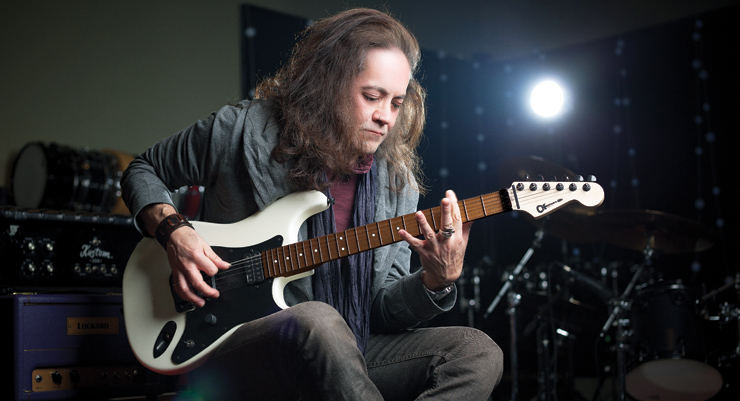

  • Warren Haynes

    Warren Haynes

    Gov’t Mule’s blues-based rock has never followed a formula, opting instead for an improvisational modus operandi that gives its music unique breadth and scope – a fact supremely illustrated in its new album, Shout!

    An 11-song outing and the band’s first studio album in four years, the double disc – recorded at bassist Jorgen Carlsson’s Rogers Boat Studios in L.A. and at Carriage House Studios in Connecticut – twists far astray even for this band, flexing its muscle through songs that more than hint at garage rock, reggae, and prog-rock-like jams, along with its usual blend of blues, soul, and R&B.

    Mule co-founder, guitarist, and creative force Warren Haynes boils it down.

    “I think this is the most diverse record we’ve made,” he said. “With every record we’ve ever done, we’ve tried to make it different from the one before, but this one covers more ground and utilizes more influences than anything else we’ve recorded.”

    On this run, the Mule doesn’t stretch its legs alone; apart from the stylistic diversity of the tunes, disc two features second renditions of each song with vocal turns by Elvis Costello, Steve Winwood, Ben Harper, Dave Matthews, Dr. John, Toots Hibbert, Grace Potter, Myles Kennedy, Glenn Hughes, Ty Taylor (of Vintage Trouble) and Jim James (My Morning Jacket). In each case, the voices give a stylistic twist, alter the energy, and sometimes even lend different meaning to each song.

    In a band known for eschewing tradition, such a move isn’t all that surprising. Haynes admits there’s a method to the madness of Shout!. “Hopefully, the other singers’ interpretations help shine more light on them, and give more people a glimpse of what Gov’t Mule does.”
    We spoke with him to learn more about the project.

    Did the songs on Shout! come together differently compared to other albums?
    I don’t know about “differently,” but it happened very organically. We took a year off, which helped us gain perspective and figure out what kind of record we were hoping to make, then all the material we wrote came together in a way that felt like us sounding like us. Each song took on its own personality. In a lot of ways, we got lucky with the way things fell into place.

    Who did what as the music came together?
    I wrote about half of the songs myself and the other half either with the whole band or [keyboardist] Danny Louis and I, and in those cases we write the music together and I write lyrics.

    What’s the story behind “Funny Little Tragedy” and Elvis Costello’s guest vocal on the second disc?
    I wrote that song when I was in California, working with Phil Lesh. As I wrote it, it seemed very different from anything we’d done, but I really liked it. When I showed it to the band, I said, “Hey, I’m not sure if this sounds like us,” but everybody jumped on it. So, we recorded it [late] one night, and when we listened back, it reminded us of the Attractions or the Clash. I had recently become friends with Elvis Costello and we’d been e-mailing back and forth a bit, so I decided to ask his advice on what kind of vocal mic to use to get an authentic, era-specific sound. He sent a nice note back, talking about different approaches he had taken in the studio. Thanks to his help, it worked out great, but it also kind of planted this seed that got me thinking, “Wow, it’d be nice to hear him sing the song.” A similar thing happened with “Scared to Live,” which I thought sounded like Toots and the Maytals, and again with Dr. John with “Stoop So Low.” As the songs were recorded, we were just thinking out loud about how it’d be nice to hear those guys. At some point, we became halfway serious about asking these guys to come in and do cameos, but it seemed a shame to have somebody of that stature sing a small part, so eventually we came up with the idea to have them sing the whole song. And that led to, “Why don’t we just make a bonus version of every song?”

    It seemed like a unique concept; there’s nothing new under the sun, but to my knowledge nobody had done something quite like this.

    There are songs sung by artists who were pretty influential to you, like the Costello and Toots Hibbert tracks, and then there are some by contemporaries like Grace Potter or Dave Matthews. Were you deliberately going for a multi-generational mix?
    Not really. I made a list of who I’d like to hear sing these songs, and it just worked out that half are older than me and half are younger. I didn’t want it to be all people who were “influences,” so to speak, and I wanted to also acknowledge contemporaries I admire. In most cases, these people are friends or I have some sort of working relationship with them, but the most important part was about whose voice would marry best with the song.

    Did you change the mixes on the guest vocal tracks?
    Yes, the arrangements are all different, and in a lot of cases the guest-vocal versions are shorter because we wanted to shine more light on the song and the singer. The only exception is the Dr. John version of “Stoop So Low,” which is actually longer because we made a point of extending the arrangement. The Ty Taylor version of “Bring On the Music” and the Jim James version of “Captured” are shorter. The Ben Harper version of “World Boss” is also shorter, less jammy at the end.

    HAYES_02

    Is there anything on the disc that might surprise Gov’t Mule fans?
    A lot of it will, in some ways, because of its diversity. But anybody who has followed us in recent years would have seen us heading in all these directions. If someone had heard only the first couple records then listened to the new one, it might seem like quite a change; it has taken time to build to this because as time goes on we utilize more and more of our influences. No band or artist wants to continue doing the same thing over and over – you want to break new ground and experiment.

    It’s been exciting because the philosophy behind it is based on our live performances. If you come to a Gov’t Mule concert, you’ll see a lot of types of music in a three-hour show. The album is somewhat indicative of that.

    That said, what will hardcore Gov’t Mule fans most appreciate?
    I think it’s the strongest record, front to back, that we’ve made. I hope the hardcore fans respond the same way a new fan would.

    What gear did you use on the tracks?
    For most of it, I used my ’69 100-watt Marshall plexi and my signature Les Paul. I also played my ’61 dot neck ES-335. I tracked “Scared To Live,” “No Reward,” and “Funny Little Tragedy” with a PRS SE Mike Mushok Baritone and tuned B to B.

    The first three tracks – “World Boss,” “No Reward,” and “Whisper In Your Soul,” were recorded in L.A. and I didn’t have any of my gear, we were just writing and recording what we thought were going to be demos, but a few turned out so well we decided to keep them. For “World Boss,” “Whisper In Your Soul,” and “Done Got Wise” I borrowed a Komet amp from my friend, Pete Thorn. That was my first time playing through one, and I really liked it. On “World Boss” I played an Epiphone Crestwood that was hanging on the wall in the studio; for “Done Got Wise” I used an Epiphone 12-string that was also hanging on the wall. I tuned it to an open E7, which is how the song was written. I discovered that tuning by accident – I was trying to tune it to a open E and but I didn’t get the D string all the way up. I started playing, and it sounded really good. “Whisper In Your Soul” is my Les Paul through that same amp.

    That’s pretty much it. I used my Caesar Diaz head on a few things and a Super Reverb on a couple of songs, but the Marshall got the most play.

    Which guitar did you use for slide parts?
    Usually a Les Paul. I keep one that lets me go back and forth at any given moment.

    Are there any personal highlights – a favorite tone, solo, or lick?
    Well, I really love the sound with the Marshall and the Les Paul on “Bring On the Music,” “Captured,” and “When The World Gets Small.” They’re very, very old-school. I had the Marshall 4×12 cab right behind me when I was playing, so I could get that feedback. That amp is really loud and sounds best when I crank it up, but I hadn’t used it in a long time. For some reason, for this record I wanted to dust it off. I really dig those sounds, but I also like the sounds I got through that Komet, and the baritone stuff is very interesting. I’d never recorded a baritone, and it’s a huge sound, especially for solos.

    Which amp did you use with the baritone?
    Mostly the Marshall. We set up two sounds – dirty and clean – and I’d bounce back and forth. Even a lot of the really clean sounds were recorded with the Marshall, and it sounded really cool. I like that some of the clean sounds are not completely clean – I don’t gravitate to super-clean sounds; I like to turn the guitar up and down to get that variation. The solo on “Done Got Wise” is the baritone through the Marshall, and I overdubbed that because I was in that crazy tuning and couldn’t play a solo.

    Which songs did you track with a Super Reverb?
    “Forsaken Savior,” and I overdubbed the solo on “Whisper In Your Soul,” which is a Firebird through that amp.

    The band has had a steady lineup for five years…
    Yeah, Danny has been in the band for more than 10 years, and Jorgen for about five. And of course, [co-founder and drummer] Matt Abts and I have played together on and off since 1986 – we met when I started playing with Dicky Betts.

    Given that span of time, you’re obviously comfortable with the dynamics and with what each guy brings, musically…
    Oh, yeah. This is one of those bands where everybody plays with their own personality, regardless of the song. We take a jazz approach to even the more-basic rock songs, and sometimes go from fairly complex to straight-ahead. But we’re always listening to each other and respond to what each other is playing, like a jazz band or a blues band. And none of us really know what we’re going play until we hear what the others play; there’s some sort of musical conversation going on all the time, and a chemistry that really works. The longer this band stays together, obviously, the better it sounds. It’s in a really good place right now.

    You do some crazy things a couple times each year, like at your Halloween and New Year’s Eve shows, where you’ve done things like cover all of Who’s Next? or do a couple hours of Rolling Stones songs. Even though there’s more musical structure in those settings, does it still command everybody’s focus onstage?
    Yeah, when we’re covering somebody else’s songs, we’ll focus a little more, but we take same approach to anything we do, with the interplay, because we want there to be some looseness. Most of the influences we really love had that approach – it wasn’t until the late ’70s that rock and roll started getting so part-specific.

    A lot of my favorite rock and roll was made by people standing in a room, playing together. Keith Richards talks about the chemistry he and Charlie Watts and Bill Wyman had, and how unique it was when the three of them played together. It automatically sounded a certain way.

    How much rehearsal is involved in those cover shows?
    It depends. Sometimes we cram tons of rehearsal into a few days. But we’re trying to get smarter about it and start rehearsing weeks or months in advance. A lot of work goes into it, even if it’s a record or a band we’ve listened to our whole lives. Learning songs enough to do them justice sometimes takes a lot of work.

    Gov’t Mule is finishing the summer playing festivals mostly, right?
    Yeah, and with the album coming out, we’ll be busy for the following year or so going back and forth to Europe and all over the States doing tons of our own shows, shaking it up.

    Are any of the guests who sang on the album going to make appearances at concerts?
    Yeah, part of the plan is to see when and where we can get some folks out, and maybe get a few shows that have multiple guests. And next year is our 20th anniversary, so we want to tie it all together.


    This article originally appeared in VG November 2013 issue. All copyrights are by the author and Vintage Guitar magazine. Unauthorized replication or use is strictly prohibited.


  • Bobby Womack

    Bobby Womack

    Bobby Womack
    Bobby Womack: Columbia/Legacy.
    Guitarist, soul singer, and songwriter Bobby Womack passed away June 27. He was 70 and had suffered from diabetes, Alzheimer’s, and cancer.

    Womack’s career spanned more than 50 years. His soulful essence and music had a far-reaching influence on contemporary music around the world. His expansive catalog crossed musical boundaries, ethnic groups, and left an indelible fingerprint on rock and roll, gospel, soul, jazz, country, and R&B.

    Gifted with one of the most enviable singing voices in rock or soul, Womack had the down-home grit of Otis Redding and the mellifluous fineness of Sam Cooke. He could gently caress with a beautiful melody, or scream like it was the hottest day in a black church. His career began in the early 1950s as a member of The Womack Brothers and he eventually became a protégé of Sam Cooke, who gave him his first record deal with The Valentinos.

    He toured the chitlin’ circuit with Jimi Hendrix on R&B package tours, and played guitar on several Aretha Franklin albums. He scored his first hits with a cover of The Mamas & The Papas’ “California Dreamin’” in 1968, and “Lookin’ For A Love,” which was later covered by The J. Geils Band. The Rolling Stones covered his “It’s All Over Now,” and he wrote “Trust Me” for Janis Joplin for her album, Pearl. He went on to write “I’m a Midnight Mover” and “I’m In Love” for Wilson Pickett, scoring even more hits.

    As an in-demand session guitarist, Womack played funk rhythms and sultry melodies on albums by Joe Tex, King Curtis, Ray Charles, and wrote “Breezin’” which became a huge hit for George Benson. “Woman’s Gotta Have It” became Womack’s first single to hit #1 on the R&B charts.

    Womack could be found anywhere there was soul-stirring funkiness. He contributed to the famous There’s A Riot Goin’ On album by Sly & The Family Stone, and in ’72 wrote the score for the film Across 110th Street, which is widely considered one of the best movie soundtracks of all time.

    Womack’s career began to slow due to drug abuse and the death of his brother, Harry, in 1974. In ’81, his career was revitalized with “If You Think You’re Lonely Now,” which peaked at #3 on the R&B singles charts. The album The Poet where the song can be found marked the pinnacle of his career, reaching #1 on the R&B charts.

    In the ’80s, Womack fought drug addiction, and by the mid ’90s had beaten it. Through the remainder of his life, he continued to be prolific while battling diabetes, pneumonia, Alzheimer’s, and colon cancer.

    He was inducted into the Rock and Roll Hall of Fame in 2009, and in 2012 released The Bravest Man In The Universe. Just prior to his passing, Womack was working on the album The Best Is Yet To Come, with Snoop Dogg, Rod Stewart, and Stevie Wonder.

    Womack is survived by Regina Banks and four children.


    This article originally appeared in VG‘s October 2014 issue. All copyrights are by the author and Vintage Guitar magazine. Unauthorized replication or use is strictly prohibited.


  • Richie Kotzen

    Richie Kotzen

    KOTZEN_01

    Veteran guitar monster Richie Kotzen has done it all from opening for The Rolling Stones, recording with Stanley Clarke, to coming to the rescue for Poison and Mr. Big. Having recorded a stack of solo albums, he now joins former Dream Theater drummer Mike Portnoy and Mr. Big bassist Billy Sheehan, to form The Winery Dogs, who have released a heavy rockin’ effort packed with gargantuan musicianship and vocals, big hooks, and blue-eyed soul. VG caught up with Mr. Kotzen to get the story.

    How did you come together with Billy Sheehan and Mike Portnoy to form The Winery Dogs?
    From my perspective it really came through radio personality Eddie Trunk. I was thinking out loud to my buddies that it would be cool to do a band project again. Suddenly out of the blue I got a phone call from Eddie Trunk. He was talking about how Mike Portnoy and Billy Sheehan were looking to do a power trio. They needed someone that could sing and play guitar. Eddie suggested me.

    It was Mike Portnoy who actually called me and opened the door. We decided to get together at my house and come up with some ideas, jam, and see what happens. In that initial meeting we spent the day together and recorded three or four instrumental ideas that would eventually have vocals.

    Those guys went off on tour and I marinated on what we had done. I remember writing two of the songs and finishing the lyrics. The guys liked it so we decided to get together again. Over the course of a couple of meetings we realized we had some inspired work. We decided to move forward and ended up making a record.

    It sounds like everything fell into place quite naturally, including the songs you started.
    It was a two-fold process in making the record. We got together a couple of times and threw around a bunch of ideas and constructed verses, choruses, bridges, and solo sections. We recorded rough demos of those and I developed them into songs. I sent those back to the guys and I got their feedback, then tweaked that accordingly.

    I would say that process made up for at least half of the record. The other half were ideas that were lurking on my hard drive. I remember playing some stuff for the guys that I had in progress. A couple of things they liked. One of them was “I’m No Angel.” That was a song I pretty much had in the can.

    In the process of working we put some things together. There were two songs that I finished that I brought in. One was “Regret” and the other was “Damaged.” They were pretty much ready to go and the guys liked those, so we put them on the record. Then there was one that Mike took from the original sessions and wrote lyrics to. That was interesting for me because it was the first time I ever recorded a song that was coming from me, where I didn’t write the lyrics. On “You Saved Me” Mike wrote the words and the melody.

    Despite having strong individual styles, the record has a unified sound.
    All of us have our sounds and what’s interesting about this record is that element has not been lost. When you hear the record you know it’s me singing and playing guitar, but when you hear the drums and the bass, you know it’s Billy and Mike.

    Sometimes in situations where you’re thrown into a room with guys who have strong personalities, it’s easy for somebody to get lost. That didn’t happen. The thing that I love most about the record is that everyone’s personality is still there. None of our personalities compromised the other person’s personality. I think that’s important and what makes the record special.

    Did you do anything different in terms of your guitar sound?
    I had my Fender Vibro-King, a Custom Vibrolux, my Bassman, and my Marshall 2×12 cab with the little head. It’s like the 1974 combo but it’s the 20-watt head version. Then I had a 100-watt Marshall plexi through a 4×12 in the isolation booth, and an amp I built from a kit that’s basically a tweed Deluxe. They were all setup and mic’ed so I was able to experiment and try different things. Most of what I ended up using on the record was the Fender stuff. I get better tone out of a combo, so I’ve kind of abandoned the 4×12 cabs. It’s a lot clearer. It’s still got gain, but it’s not that fuzzed-out gain. When you play fast you want that clarity. You have to find that sweet spot where you get in-between where the gain is out of control, and in control.


    This article originally appeared in VG November 2013 issue. All copyrights are by the author and Vintage Guitar magazine. Unauthorized replication or use is strictly prohibited.


  • Steve Miller

    Steve Miller

    Steve Miller. All photos by Tim Brown.

    Though obviously a familiar name given his hits from the 1970s and ’80s were FM staples and today are virtually ubiquitous on classic-rock radio, last month we talked with Steve Miller about his less-discussed musical pedigree. Literally raised in the company of some of the biggest names in guitar music (Les Paul, T-Bone Walker, etc.), by age 12 Miller was earning money as a musician before eventually moving to Chicago to make a living playing the blues, then attaining superstardom after releasing a string of hit singles and albums.

    Though never much into vintage guitars, Miller is nonetheless a prolific guitar collector who works with some of the best-known luthiers, creating custom instruments.

    We pick up the conversation discussing how he came to possess a small army of recent-issue Gibsons.

    You recently went on a hunt for good Les Pauls. What were you looking for – new stuff, vintage stuff?
    I was looking for both. In 2006 I was awarded the Les Paul Tech Award at the TEC Foundation for Excellence in Audio’s Technical Excellence and Creativity Awards show, and was presented a Les Paul ’59 reissue. It’s a beautiful instrument and a lot of fun to play. In fact, a lot of the solos on (Miller’s new album) Bingo! were done with that guitar.

    A while after that, I was at Chicago Music Exchange looking for a Gibson doubleneck. I tried a few and wasn’t satisfied, and they had the Jimmy Page-signed version on the wall. I said, “Okay, bring it down.” So the guy pulls it down, and it’s one of 200 doublenecks that Tom Murphy put together. It was the first time I had seen one of his, and what a great guitar, especially the six-string SG section. I was knocked out. It turns out they had 11 doublenecks, and I tried them all. Suddenly, I was very impressed with what Tom Murphy and the Gibson Custom Shop were doing.

    So I bought three of them and started looking for a “Murphy’d” Les Paul. Just as we were starting last year’s tour, I heard there was a Billy Gibbons Pearly Gates version coming out; I love the way Billy plays and I love his tone, so when I heard the Reverend was giving up the secrets, I jumped right onboard – his tone is so cool!

    So, Scotty – my manager, who’s a guitar nut too – said, “Let me call around and see if I can find one. I played one and I think you’re gonna really love it.”

    So we started looking, and I’m on the road when these two signed Billy Gibbons guitars show up – numbers 15 and 16. I tried them, and without a doubt, these guitars are the real deal. I mean they sounded so good; I started using number 15 onstage that night. I was delighted with how it felt, how it played, and especially with how I sounded on it. Then I found a couple of aged ones, serial numbers 22 and 23, and they were amazing, too. I started asking myself, “Wow, what is going on here?” Wherever we went, we started visiting whatever guitar stores were in that city.

    Eventually, I ended up at the Gibson Custom Shop and met all the guys building these guitars. They were wonderful. I was so impressed by what they had accomplished. I couldn’t believe the quality of the guitars that were coming off that line. The five hours I was there, a lot of guitars got finished, and I played them all. All of them I have are really wonderful, easy to play, set up perfectly, and sound wonderful. We started recording with them, and I take four on tour with me.

    The Storm-Thorgerson-designed cover of Steve Miller Band’s new album, Bingo!

    You’ve also been talking with Gibson about building some customs, right?
    Yes, I’m getting ready to place an order after trying a lot of different artist models, incorporating everything I’ve learned from them and have figured out playing my pearly gates for a year and from talking to Les himself over the years and his son Rusty about Les’ personal guitar.

    The Gibson Custom Shop does some nice work.
    I think they’re at the pinnacle of the guitar building history. I really do. This is the golden age for Gibson – it will be hard to get better than this. I’ve tried more than 30 Les Pauls and any of them would knock anybody’s socks off. There’s not one bad one in the bunch. And Tom Murphy, Pat Foley, Steve Christmas, and all the guys at the Custom Shop are to be congratulated for their hard work and the fine instruments they’re producing. There are a hundred men and women at the Custom Shop who are all very serious about their work, and they’re turning out wonderful guitars. Jimmy’s doubleneck 12-strings is priceless to me – I love them. They’re wonderful instruments, and Tom Murphy has done a great job. I prefer the Murphy guitar or a VOS, and before I tried them I just thought that was all a gimmick.

    You said you have four of those on the road. What else are you taking on tour this year?
    I just went through everything with Wes Leathers, my guitar tech, and we’re taking new Martin J-12-40E 12-strings that are really right on the mark. I’m using those for my acoustic sets, some different tunings – B, D, and E. I also use the D-45 and a D-41 for my acoustic set.

    Are those newer Ds?
    Well, I’ve been using them for the last 15 years. They’re well-played-in road guitars. I’m taking six John Bolin Strats with custom pickups made by Seymour Duncan, two BillyBo guitars with TV Jones pickups, a new Custom Shop VOS Les Paul Junior that has a P-90 that sounds like it’s a foot deep that Steve Christmas steered me to, and a couple of Bolin N/S guitars with custom electronics by Haz. I introduced Ned Steinberger to John Bolin, and John built the N/S models for me. Ned’s been a good friend for years; I’ve played lots of his guitars in my shows over the years.

    John Bolin Guitars

    For more than 20 years, Steve Miller has been working with luthier John Bolin to create unique instruments – solidbody, hollowbody, basses, etc. Here are a few.

    I also have two CV Guitars, they are called PG Mods; Larry Corsa puts them together using Les Paul Standard fadeds with Manalishi pickups with an out-of-phase Peter Green setup, and they are great guitars, too. They’ve got great tone.

    My search for the ultimate tone continues. I’m playing a Wildwood Gibson LP mod with a double-cut maple top, and they carve both sides of the maple top, which creates a small tone chamber. They had Gibson make 25 of them. Then, I ran into a client of Bolin’s who’s owns an original ’53 Les Paul goldtop, an original ’59 Les Paul Standard, and an original ’57 Strat, and I asked him, “Would you bring those to our gig?” We were doing a tribute for (late bandmate) Norton Buffalo at the Fox Theater in Oakland in January; he graciously brought all three – the ’59 was formerly Eric Johnson’s, with “Buddy” written on the pickguard. It was great to play the real deal and see what it really sounded like ’cuz I hadn’t played a real ’59 in so long, you know? And it was this lovely, sweet, clear-sounding guitar. It had all the stuff you wanted, and its lower strings had a clearer tone. You had to crank the amp up a little more, but once you did, the thing started to sing. It wasn’t as hot as a Burstbucker pickup, but it was clearer-sounding and a little sweeter, more musical. That’s why I started looking at Les Pauls again. I thought, “Okay, I get it.” I like that sweet sound more than I like just a super-hot sound. So in the end I think it’s all about pickups, really. The instruments that Gibson is building are as perfect as I could ask for especially when they have been Plecked… I see any new Gibson Custom Shop Les Paul as a perfect platform for whatever pickups you like. I pick the instruments that feel best and the neck that suits me the best – it isn’t about finish or color or whatever. I’ll change pickups all day long just to find the perfect match. I talked to Seymour Duncan after playing the ’59 and described to him what I thought I was hearing and he sent me two sets of pickups that were not wound as hot, and they sounded really good. You just sort of have to crank your amp up a little bit more, and then there it is.

    Seymour’s Antiquity humbuckers have some really fantastic overtones…
    That’s exactly what I came away with, and man what a sweet, fat, hot sound And if you want to go over the top, just turn up the amp two numbers – there it is!

    So now I’ve got this great bunch of guitars and I’m hoping to build one with Edwin Wilson at Gibson’s Custom Shop that has a combination of all the right parts and pieces for my tone and me.

    1. A Tom Anderson Guitarworks Drop T with graphics inspired by Native American art. 2. A Steve Andersen custom. 3. A Steve Andersen Emerald City. 4. A Jim Triggs New Yorker. 5. A Jim Triggs solidbody with mother-of-pearl covering.

    What’s in the pedal board you use live?
    The first thing is a switch that kills my microphone in the house PA but lets me talk directly to my in-ear-monitor mixer Steve McHale and the rest of the band through their in ear monitors. It’s handy for quick on the spot adjustments, messages to the house mixing engineer, or quick cues and changes to the band, the stage crew and guitar techs.

    Then, for guitar there’s a Klon Centaur I use for the Gibson guitars, a Fulltone OCD for Stratocasters – it’s weird, but they always sound different in each venue; sometimes I switch guitar setups and one just feels better than the other.

    Next is a Boss DD-2 set for when I play “Fly Like an Eagle.” Then there’s a Boss DD-2 set for short delays, a Keeley compressor, a Seymour Duncan SFX-07 Shape Shifter, and a Vox V847 wah. Everything’s plugged into a Voodoo Power supply and there’s a Radial SGI single-line transformer.

    The pedal board runs to my Dr. Z Stang Ray, which then goes to a cab with two Celestion Gold 12” speakers.

    We talked earlier (see the August issue) about how things came together so well while you were recording the songs on Bingo!. But we should also mention that you worked with renowned artist Storm Thorgerson on the cover art.
    Yes, and it was a huge project! Storm listened to all the music and did 30 drawings. I picked the ones I liked, and then he went to Spain and shot the pictures (laughs)!

    Steve Miller stage
    Steve Miller’s current stage set is more than a little “guitar-inspired.”

    Certainly no half-hearted effort! His work for Pink Floyd involved some fairly extreme concepts.
    Get this, man! We’re working on more projects, one where he’s digging a guitar-shaped hole in England that’s 60 feet long and five feet deep with people dressed in ’50s-style clothing pouring water into the guitar. For another, he did a drawing of vinyl discs coming out of the sky at an angle, landing in the desert. So we built the discs – they’re 30 feet in diameter!
    So yeah, these are these huge, surreal Pink Floydian album covers.

    And these are for your albums, like the other batch that you recorded during the Bingo! session?
    Well, I started a record company – Space Cowboy Records. Perfect time to start a label (laughs)! Thank God we have our touring income, man. Seriously, though, it’s really exciting to be working with the kind of artists I’m finding. For a really a long time, I was uninspired about making records, mainly because of the business of it. It’s like, “I feel like doing a record. But I’ve got to call a lawyer and then micro manage the company,” you know? But this is different – a lot better, a lot more interesting, and a lot more fun, which is the way I want to do it. And hell, I’m 66 years old. I don’t have a lot of time!

    Storm Thorgerson rough sketch
    Storm Thorgerson’s rough sketch for an art project involving a 60-foot hole shaped like a guitar.

    But do you still enjoy playing live?
    I never felt that way about touring. I love to tour, I love to play, I’m excited about my new stage setup, I get excited working on set lists, putting things together, working on the acoustic section of the show and figuring out this and that. I love all of that.

    But the business part is too irritating…
    Right. I wasn’t very interested in doing it. But working with Storm, working with (recording engineer/co-producer) Andy Johns, and having somebody like Joe Satriani come in… Having (vocalist) Sonny Charles join the band, having the band up for it, having the sounds sort of wake up after a long, long time…

    And with your own label, you’re the boss.
    Yes. I don’t want to be mad at a record company, so it feels really good, like it’s in our hands, not some corporation that doesn’t care. It has that feeling of the good old days, when we’d record what we wanted to record.

    And of course, these days you can’t record albums thinking they’ll make you a star. It just doesn’t work that way.
    No. The whole business is so… it’s sad. I feel bad for young musicians because there’s no place to play, no place to grow. Pop music today is people groomed by the Disney Company and put on television, then made pop stars. It’s a very hard way to go. People like me would never have a chance today. I’m not a video artist. I can’t dance and make it look great and keep my hair just right.

    The good news is I’ve found two groups I’m working with; one is The Danger Babes – two girls in San Francisco who are 20 years old, brilliant writers, and really great performers. They sound like a combination of Joni Mitchell and Crosby, Stills, and Nash, only newer and better. And then there’s Max Marshall, a young guitarist and writer from Texas. He was 12 at the time we met, and a really good guitar player. I got him to come to New York and introduced him to Les Paul, and Les brought him onstage and he got to play with Les. He’s 16 now and burning it up; he’s somewhere between the Kinks and Led Zeppelin and the Moody Blues, and a phenomenal writer. For the last two years he has been to the Berkeley College of Music, taking guitar courses in the summer. He’s a real smart kid, and very talented. I hope to finish records with both acts next spring

    Steve Miller guitars 6-10
    6. & 7. Two hollowbody electrics by Jim Triggs with artwork inspired by World War II military aircraft. 8. A custom solidbody by Joe Veillette. 9. A highly-modified/altered Gibson L-1. 10. An early-’90s Gibson J-2000.

    So, as label head, will you be producing their albums?
    I will help them produce their own albums, but they’ll call the final shots, own their own publishing, and be their own bosses. I never was interested in producing other people because they always thought if I produced them they’d become rock stars. But these two acts have the hard part down – the writing and the musical talent. They’re great musicians and writers, hard workers, and they have musical ideas, which is exciting. I’m having fun now!


    Participants in the Kids Rock Free program
    Participants in the Kids Rock Free program get their rock on; (from left) Dillon Brown, Matt Rubic, Emileen Bernal, and Alex Romero. Photo courtesy Kids Rock Free.

    Go On, Give the Money and Jam!
    Steve Miller is a huge believer in a music education program for kids age 7 to 17 called Kids Rock Free. Part of the Fender Center (a 501C charity based in Corona, California), its mission is to provide free and low-cost music lessons in piano, guitar, bass, voice, drums, and combo-band.

    “In my opinion the Fender Museum and Music school is the best designed and operated community music program in the country,” said Miller. “It was built for a reasonable amount of money, it’s self-sustaining and it focuses on teaching music by involving parents and children in a way that inspires and rewards good work. That’s why I’ve performed three benefit concerts for the school and donated substantially to the program. It works. It is the best community project I’ve ever seen and is a model for the rest of the country to emulate.”

    Since 1998, more than 12,000 students have taken part in the program, and bands from it have performed with and/or opened for the Steve Miller Band, Bad Company, Joe Walsh, Merle Haggard, Lit, Alien Ant Farm, Bo Diddley, Etta James, Dick Dale, and others.
    Fender Center and Kids Rock Free are in the midst of a fundraising and marketing effort, assisted by The John F Kennedy Center’s AIC program and designed to address the needs of 800 kids waiting to participate in the program. For more, go to fendercenter.org.


    This article originally appeared in VG September 2010 issue. All copyrights are by the author and Vintage Guitar magazine. Unauthorized replication or use is strictly prohibited.


    You can receive more great articles like this in our twice-monthly e-mail newsletter, Vintage Guitar Overdrive, FREE from your friends at Vintage Guitar magazine. VG Overdrive also keeps you up-to-date on VG’s exclusive product giveaways! CLICK HERE to receive the FREE Vintage Guitar Overdrive.


  • Echoplex EP-2

    Echoplex EP-2

    The late-’60s EP-2 added a combined instrument/echo volume-blend oscillator to its control panel, and was the first Echoplex to offer Sound-on-Sound recording.
    The late-’60s EP-2 added a combined instrument/echo volume-blend oscillator to its control panel, and was the first Echoplex to offer Sound-on-Sound recording.

    Sam Phillips didn’t invent tape echo with his mid-’50s recordings of Elvis, but he just as well may have. So influential, so inspirational were those songs – with their warm, glorious slap-back echo created in Sun’s control room by two jerryrigged tape recorders – that budding rock-and-rollers everywhere had to have it.

    With the arrival of the Echoplex, circa 1959, tape echo finally became easily accessible, and if you wanted to rock like Elvis, it was just the spin of dial and a tape loop away. And that doesn’t begin to describe the sonic adventures Led Zeppelin or Pink Floyd would take the Echoplex on. Its sounds are still being experimented with today, some 30 years after the assembly lines rolled to a halt with the last solidstate version.

    True, there were many others playing with tape echo years (even decades) before the Echoplex. Les Paul, of course, was trying everything, but his recordings featuring his homebrewed delay were not as influential on rock. Ray Butts crafted his landmark EccoSonic amp in 1953 with built-in echo – first via wire, then tape. The Ecco-Fonic effect followed circa ’59 with a spinning tape head. But neither offered the flexibility of an adjustable playback head to fine-tune the spacing of the echo. Ditto the English Binson Echorec, which used magnetic recording discs. And the Italian-made Meazzi/Vox Echomatic was hard to come by – plus notoriously temperamental.

    That adjustable playback head was the key to success for the Echoplex. It was also one of the hardest technical elements to get right during the long gestation of the machine.

    The Echoplex story starts with Akron, Ohio, guitarist Don Dixon, who began building his own tape echo effect in the mid ’50s, as he told VG’s John Teagle. Dixon wasn’t an engineer and couldn’t get the machine right, so he answered a newspaper ad for electrical repairs and met Mike Battle, also in Akron. Battle could fix or build anything electrical, and spent the next years perfecting Dixon’s creation.

    “It was three or four years before we really got it down where we wanted it,” Dixon told Teagle. “I’d say, ‘Put this back, take this out, a little more of this, a little less.’ And he said, ‘You’re just too damn particular!’ And I said, ‘Mike, if you don’t want to make the best one on the market, lets just quit.’ And he’d get mad, but, boy, he’d go in there and just do wonders with it.”

    The key was that adjustable playback head. Battle added, “A lot of the early machines… you couldn’t move the heads, you just played to fit that speed. I don’t know much about music, but how could you play all them songs to the same tempo?” He added a playback head that slid, allowing infinite adjustment to the echo spacing – within the machine’s physical dimensions, that is.

    Battle also enclosed the tape within a cartridge, which protected it and helped retain its sound quality. The cartridge’s patent-applied-for “endless loop magazine,” as early brochures hailed it, offered some two minute’s worth of tape.

    The duo also labored to get the tone just right, directed by Dixon with Battle again shaking his head over the constant revisions. “I worked on that for him for two years. He said, ‘It ain’t just quite right, Mike.’ I was getting kind of disgusted with it.”

    (RIGHT) A rare mid-’60s brochure for the Echoplex EP-2.
    (RIGHT) A rare mid-’60s brochure for the Echoplex EP-2.

    Battle’s brother, John, was a die maker, and he built the early cases and other metal parts in his basement. They first offered Echoplexes for sale in about 1959.

    “Surprised me,” said Battle, a confirmed non-musician. “These guys would come in, play it, and buy it! I’d build another. I thought these guys buying this piece of junk should have their heads examined, but they had a circus with it!”

    Soon, Dixon and the Battle brothers couldn’t keep up with demand. Battle showed the Echoplex to Chet Atkins, who tried and failed to interest Gretsch. Dixon and Battle connected with Market Electronics, a Cleveland company that produced Echoplexes and sold the first 500 to the Maestro division of Chicago Musical Instrument Company in 1959. Production was later taken over by Harris-Teller of Chicago.

    The first Echoplexes were retroactively known as the EP-1. Our Echoplex here is a late-’60s EP-2, which added a combined instrument/echo volume-blend oscillator to its control panel alongside the Echo Repeats knob. It also featured Sound-on-Sound recording, allowing infinite looping – at least for the tape’s two-minute length.

    With the rise of solidstate technology, Maestro instructed Battle to get rid of the tubes and update the machine. The solidstate EP-3 arrived in the late ’60s, about the time Maestro was taken over by Norlin Industries, then the parent of Gibson, which would sell the effect. The EP-3 was followed by the EP-4.

    “Everyone was going to solidstate… so I developed the EP-3. It was the best solidstate Echo unit on the market,” Battle said. Despite his early frustration with Dixon over tone, Battle had become enamored with tube sound. “I did not like [the solidstate] direction, so I left the company.”

    But Battle’s creation lives on. With a ’52 Gibson ES-5 into a Fender Vibro-King, the EP-2’s slapback almost makes you think you’re in Sun Studios; its tubes create a warm, rich sound – in fact, some guitarists such as the Police’s Andy Summers switch off the delay and use the Echoplex just to thicken their tone. By adjusting the echo volume, you can put the emphasis on the guitar’s original signal, or the echo. Adding more repeats and spacing out the echoes creates an otherworldly vibe.

    These days, analog and digital delay pedals are much less expensive, much more hardy, and easily replaceable. But the Echoplex – with that funky ’50s electromechanical technology and tube-driven tone – has become the standard by which everything else is measured.


    This article originally appeared in VG July 2012 issue. All copyrights are by the author and Vintage Guitar magazine. Unauthorized replication or use is strictly prohibited.


  • The Guild Starfire Bass

    The Guild Starfire Bass

    1966 Guild Starfire Bass
    1966 Guild Starfire Bass. Photo: Contrino Photography. Instrument courtesy of Walter Parks.

    In the mid ’60s, Guild took its knocks for making guitars that looked “inspired by” Gibson models. Fans of the brand think the sterotype is unfair, of course, and certainly, many Guilds from the era have their own intrigue. One very good example is the Starfire Bass.

    Guild was founded by musical-instrument importer/distributor Al Dronge in the early 1950s, and many of its craftsmen were former Epiphone employees who opted to stay in town after Epiphone moved to Philadelphia. In ’56, Dronge moved the company’s production to the top floor of the Neumann Leathers building in Hoboken, New Jersey, where it would remain until it moved to Westerly, Rhode Island, in ’67.

    Guild’s Starfire guitar was introduced in 1960 as a thinline hollowbody with a Florentine (pointed) cutaway, but models introduced in ’63 had a semi-hollow design with a “center block” and double Venetian (rounded) cutaways, a la Gibson’s ES-335-anchored thinlines.

    The Starfire Bass debuted in ’65, its design obviously influenced by Gibson’s EB-2, which had been around since ’58.

    From the top down, the Guild has the well-known center-hump headstock with two-per-side tuners, “peaked” logo, “Chesterfield” inlay, and a shield-shaped truss-rod cover. Its neck is made from Peruvian mahogany and has a rosewood fingerboard with 21 frets. Scale is 301/2″.

    The body was the same one used on Starfire six-strings, measuring 161/2″ wide and 17/8″ deep (even if the catalog says it’s 2″!).

    The wood used to make the body varied with the finish – sunburst instruments (and the occasional natural-finished example) in the line were given maple bodies, while cherry-finished versions were made of laminated mahogany. A typical Guild sunburst finish had a more orange-ish tint in its lighter portion than did a comparable Gibson.

    Binding on the Starfire Bass’ top was three-ply (white/black/white) and the original version sported two parallel handrests. The bridge/tailpiece was made by Sweden’s Hagström, and had rosewood saddles that could be intonated individually.

    The original pickups also came from Hagström, and there are significant differences between the single-pickup Guild and its Gibson counterpart; the EB-2 had a pickup in the neck position, while the potent Hagstrom Bi-Sonic pickup on the Starfire was roughly in the center of the top.

    The Starfire is touted in Guild’s ’66 catalog as having “…the acoustical advantages of a hollowbody guitar in a double-cutaway bass with famous Starfire features. Aided by the resonance of its arched top, this guitar propels your group with the tight, strong sound that keeps the other instruments rocking right along.” (Yes, the text does refer to the instrument as a guitar…) The owner of the bass you see here, Walter Parks, believes the placement of the pickup helps validate the catalog’s claims.

    “It provides a marvelous detail that a neck-position pickup doesn’t,” he said. “In most situations, the treble needs to be dialed down considerably. The pickup thereafter becomes robust, yet still provides plenty of point and focus to the note. There’s noticeably more sustain in the bridge-pickup model, probably because there’s more top wood resonating. And while they’re electric, mid-’60s Guild basses have wonderful acoustic properties.”

    Parks’ band, Swamp Cabbage, plays funky blues on old Guilds exclusively and rehearses in the old Neumann Leathers building in Hoboken!

    A two-pickup Starfire Bass was introduced in ’67, and was popularized during the psychedelic movement by Jack Cassady of the Jefferson Airplane and Phil Lesh of the Grateful Dead (some examples modified by the up-and-coming Alembic company).

    By the early ’70s, the Starfire’s pickup was moved to the neck position, with a Guild humbucker replacing the Hagstrom Bi-Sonic (though neck-position versions with Bi-Sonics stayed in production for some time). Handrests were moved, offset between the pickup and bridge, and the bridge plate acquired an asymmetrical silhouette that referenced the harp-shaped tailpiece found on many Guild electric guitars.

    The single-pickup Starfire Bass was discontinued in ’75, and while it may not have the historical significance of the Gibson EB-2 or its two-pickup Guild sibling, players and collectors know it’s another example of Guild’s underrated ’60s instruments.


    This article originally appeared in VG January 2011 issue. All copyrights are by the author and Vintage Guitar magazine. Unauthorized replication or use is strictly prohibited.


  • Alex Machacek

    Alex Machacek

    ALEX_MACHACEK

    When you get the thumbs-up from icons like John McLaughlin and Chick Corea, it’s got to feel good. But, fusion guitarist Alex Machacek isn’t one to rest on his laurels, and he recently recorded Now, a lush piano-and-guitar duo with drummer/pianist Gary Husband. The album explores a different side to Machacek’s musical personality.

    How did you prepare for recording Now?
    Abstract Logix proposed the project, and once we started writing, we’d send each other demos and took it from there. Unfortunately, we had no rehearsal time; Gary was on tour with John McLaughlin.

    Gary and I are known for rather busy music, but this was supposed to be very intimate. I think it was a good to show a different side of each of us. The only deviation was where I asked him to play percussion on one of the tracks behind my acoustic. There’s a tiny bit of hand-drumming that was supposed to be with his hands on the piano, but the piano goes out of tune easily. I said, “Drum something on an acoustic guitar.” He turned it around, put it on his lap, and played a little hand percussion. Other than that, it’s just piano and guitar, and that was the goal.

    Did you do anything different to play with that sense of intimacy?
    Not really, because I have a duo with my wife – she’s a singer and I’m used to accompanying her. We were working on a duo album in L.A., and people were surprised to hear me play clean. If I hear a punk guitarist, why should I assume he’s a great classical player? I don’t blame people for not being aware I have other ways of playing.

    Do you care what your fans expect?
    Of course I do. But then, if I like it, I feel good about it, and I feel good about presenting it. I think an artist should stand behind what he’s delivering. I can’t care too much, because I don’t know all my fans. One guy says I should go more into rock, and another guy says I should go into jazz. You can’t please everyone, so you’re left to your own devices. You just try to give your best in whatever you do.

    Are you concerned at all with making commercial music within your genre?
    There are other people who make music for a specific purpose. I make music the way I feel I want to. I’m not rich and I will not be rich, so why should I, in any way, compromise my music? I’m just doing what I’m doing and trying to be honest about it. I wouldn’t feel comfortable trying to target a demographic.

    What is your main guitar.
    It was made by Bill Delap, a luthier from Monterey known for building guitars Holdsworth used to play. A very generous friend gave me this one. The universe said, “This is your guitar.” I didn’t agree with the universe, but after a year, I started agreeing with the universe! It’s a hollowbody, and I’m a big fan of the headless design. It has good, substantive tone that other guitars just don’t have.


    This article originally appeared in VG March 2014 issue. All copyrights are by the author and Vintage Guitar magazine. Unauthorized replication or use is strictly prohibited.


  • Korg Nuvibe

    Korg Nuvibe

    Korg NuvibeKorg Nuvibe
    Price: $499.99 (street)
    Contact: www.korg.com

    Korg is not known as a guitar company, but to their great credit they worked with Fumio Mieda – developer of the original Uni-Vibe from 1968 – to resurrect his classic modulation effect as the Nuvibe.

    A late-’60s Uni-Vibe is like the snow leopard of guitar effects; seldom seen and awesome to behold. But Mieda could not simply re-create the Uni-Vibe from 40-year-old schematics because the photocells central to the circuitry contained cadmium, which is toxic and no longer available. (Plus, it turns out the original schematics were inaccurate.) So he wondered: How close should a copy be to the original – and should it also emulate the original’s shortcomings?

    Tone was the top priority, and the Chorus and Vibrato effects on the Nuvibe are deeply satisfying and genuine. The Chorus is not like a modern chorus pedal, but rather a chewy, phased effect. This is the sound for which the Uni-Vibe is revered, and it’s achieved in the circuit by mixing the subtler Vibrato effect with a dry signal. Chicken-head dials control the intensity of the active effect (chosen by footswitch) and the speed of the modulation. The Expression pedal, which is included, enables speed control by foot and overrides the Speed knob. A third dial for volume adjusts the output, which is at unity when set to Max.

    A major departure from the Uni-Vibe is the Nuvibe’s addition of 10 sliders for shaping the LFO waveform. White markers denote positions for the original LFO, and users now have the freedom to adjust the oscillation. Red LEDs on the faders provide a real-time visual of the wave, which is very helpful when adjusting to remove an audible pop or peak. Also, it looks way cool.

    Purists will appreciate the Nuvibe’s gorgeous tone. Given the vintage dimensions (10.24×6.69×2.64″, plus full-sized foot pedal), they’ll have to really want it, too. At a time when stompboxes are becoming small enough to be choking hazards, the Nuvibe’s ginormous footprint is an obstacle.

    Players will have to judge the Nuvibe’s size and features according to their own needs. Do you require adjustable LFO or a pedal to control speed? Would you shell out for an excellent repro to complement your vintage rig? On balance, players who dig a vibey swirl have some very nice options available at one-third the size and less than half the price. But guitarists who are just nuts for the complete vintage vibe will be in Hendrixy heaven.


    This article originally appeared in VG May 2015 issue. All copyrights are by the author and Vintage Guitar magazine. Unauthorized replication or use is strictly prohibited.


  • Lazy J Cruiser Deuce

    Lazy J Cruiser Deuce

    Lazy J Cruiser Deuce

    Lazy J Cruiser Deuce
    Price: $420
    Info: www.lazyjprojects.com
    .

    The Lazy J Cruiser Deuce is more complex than your classic stomp-and-go pedal, though its functionality is intuitive.

    The Cruiser Deuce’s brown finish and cream knobs (Gain, Volume, Drive, and Sat, i.e., saturation) give it a vintage look; In/out jacks on the side, two footswitches, and a mini toggle round out the operative parts. It operates like a two-channel amp – Gain and Volume knobs control the Boost channel (activated by the left footswitch), while the Drive and Sat knobs control the Drive channel (right footswitch) and the mini toggle governs the degree of compression through the Drive channel. In the middle position, it offers no compression, up employs a medium degree, down offers the greatest compression.

    Plugged in between a Stratocaster and a late-’50s Ampeg Jet set for a little natural breakup, the Cruiser Deuce’s Boost (with Gain and Volume set at 12 o’clock) gave the amp greater clarity and presence.

    With the Gain all the way on, the Strat produced overtones an octave higher on the sustained notes, even in selector switch positions two and four, where pickup frequency cancellation offered less output. Chords at full gain were crunchy but not too dirty, with audible note-to-note separation. And the seemingly endless sustain and harmonic richness of single notes was very musical.

    Punching the right-side footswitch to engage the Drive circuit; set at noon, the controls caused other harmonics from the overtone series to blossom. Adjusting the knobs brought varying degrees of serious crunch, though the mini toggle effect was subtle at low volumes. Cranked, the levels of compression became more obvious. With both channels engaged, subtle adjustments of the knobs revealed various levels of expression as the channels interacted.

    Run with a set-neck solidbody with a Charlie Christian-style pickup, it achieved that slightly overdriven sound of a late-’30s ES-150 through a small Gibson amp.
    Experimenting a bit through a solidstate amp and an archtop with a Fishman Powerbridge, the Cruiser Deuce’s Boost mode worked very well as a preamp to fatten the piezo bridge response over the entire frequency range. Because the Cruiser Deuce doesn’t change the bass, mid, or treble levels, the lack of tone controls never felt like an issue with any of the guitars.

    Got your eyes set on a boutique amp, but just can’t swing right now? The Cruiser Deuce just might just do the trick!


    This article originally appeared in VG June 2014 issue. All copyrights are by the author and Vintage Guitar magazine. Unauthorized replication or use is strictly prohibited.