This Valentine’s Day, MusicNomad is asking one big question: Has your guitar been KISSed? Show your guitar some love with a KEEP IT SIMPLE, SETUP (KISS)™ using your favorite MusicNomad setup products, then snap a photo or short video of you kissing your newly setup guitar with the setup kits in the background and post it on social, tagging @musicnomadcare and using #kissyourguitar for a chance to win big.
Every unique setup post counts as an individual entry and they will announce the three lucky winners on February 14th on their social channels – so make sure you’re following along. If you’ve never done a KISS setup before, they’ve got you covered. Grab a 6 pc. KISS Setup Kit and follow along with their free setup booklet and videos. Join tens of thousands of musicians who use their KISS tool kits to have their guitars look, sound and play the best.
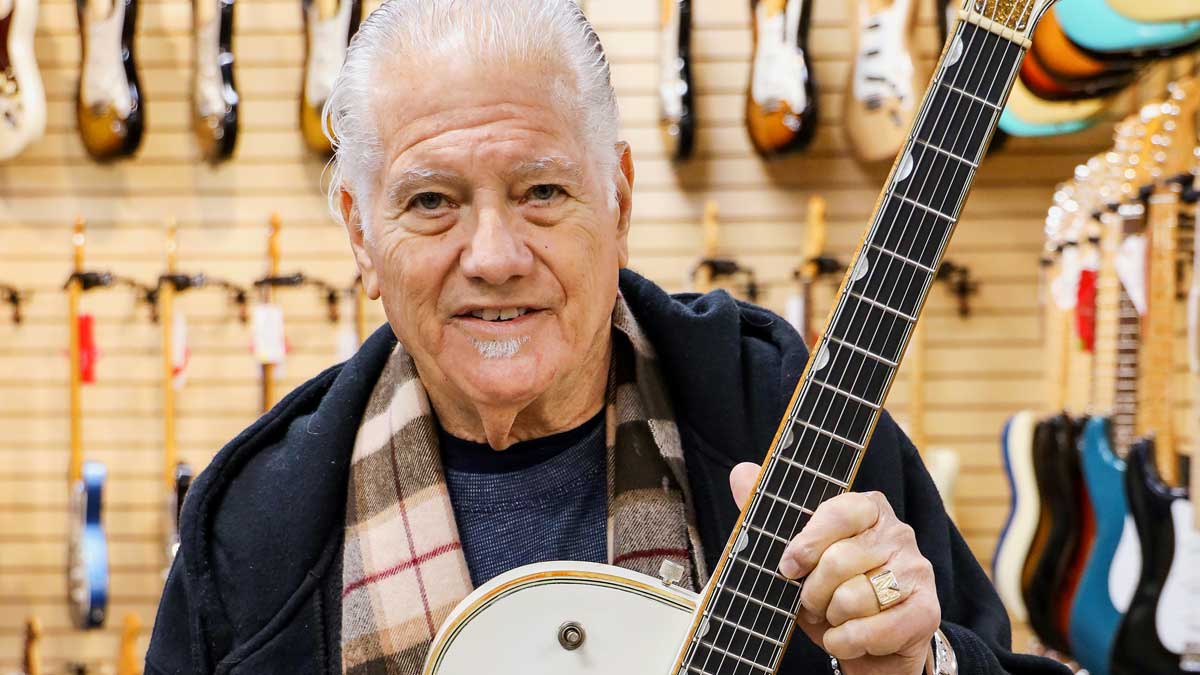
Norm Harris with a single-cut ’59 White Falcon with Filter’Tron pickups, one of perhaps a dozen that have come through his shop in 50 years.
As a teenager who just wanted to play music, Norm Harris lived with the reality that he and his band weren’t going to be millionaires anytime soon. So he did what musicians do – side-hustled. But when most were manning the counter at a music shop or serving tables, Harris was up at the crack of dawn, chasing guitars.
He and other pioneers in the business of buying and selling old guitars had the wind at their backs in the late ’60s. As musicians discovered that new Fenders, Martins, and Gibsons didn’t sound, feel, or play like old ones, they started buying any and every ’50s and ’60s guitar and bass they could find. Their foresight and hustle have been handsomely rewarded.
We caught up to Harris, 76, a few weeks after the Netflix debut of a documentary film (see sidebar) that recounts his life and examines his renowned Los Angeles guitar store, Norm’s Rare Guitars, along with his charity work and use of social media to highlight musicians. Conceived by his daughter, Sarah Edwards, as a way to preserve her father’s story for his grandchildren and give a filmmaker friend work during the pandemic, it stirred a tidal wave of publicity that caught the humble Harris by surprise. We spoke with him just after he’d received word that a crew from “CBS Mornings” was on its way.
You’re one of the foremost experts on vintage guitars, but you got into music studying piano and playing keyboards in bands. Yeah, I grew up in Miami and started playing when I was nine or 10. My dad was very supportive of me playing music, and when he saw that I was really into it, he got me four piano lessons per week.
What sort of music influenced you most at the time? I stumbled across two radio stations – WMBM and WAME – the “black” stations, and just loved the music, so I started following a lot of black artists.
What was your first band experience? When I was 13 or 14, I played in a group called the Majestics, which was trumpet, saxophone, drums, and me on piano. When I was 15, I formed The Aztecs, which had guitars and bass. We were kids just trying to figure it out, doing R&B, blues, and rock covers in local places. From there I went to a band called The Glass Menagerie and then one called the Bangles with two Miccosukee Indian brothers, Lee and Steve Tiger.
When did it go from a club band to the next level? After the Bangles, I became friends with Bobby Caldwell and we formed Katmandu, which played around Miami and Fort Lauderdale. A place called The Image would bring in a major act every week, and we were one of the house bands that opened, which we did for Jimi Hendrix, Cream, the Amboy Dukes, and Chambers Brothers. At the Miami Beach Auditorium, we opened for the Allman Brothers, but they might have been the Allman Joys at the time.
Joining Katmandu started you down the path asan instrument dealer… Yeah. There were two guitar players, Bobby Caldwell and Bobby Jabo, and they’d take turns playing whichever bass we could borrow because neither of them owned one. So, I figured I’d buy one and learn to play, but while I did, they could use it. In the Miami Herald classifieds, I found an ad for an electric bass. I went to look at it – it was a ’62 Jazz – and the guy settled on $125. As he was writing the receipt, I noticed his name was Frank Williams. I asked, “Are you from Frank Williams and the Rocketeers?” and he was blown away – couldn’t believe this 18-year-old white kid knew who he was (laughs), but I was a huge fan from hearing them on WMBM and seeing them play at The Night Beat and Island Club. They had a great guitarist named Willie Hale, whose stage name was Little Beaver.
At the time, we were playing double bills with Billy Burke’s organ trio, Woodchuck. His bass player was Jaco Pastorius (we became friends) and he constantly asked about buying it. After he kept pestering us, it occurred to me that I could sell used guitars to the players in town. So I started getting all the newspapers and I’d drive to pawn shops, thrift stores, and music stores because a lot of music stores wouldn’t take older instruments in trade. I became known as the local idiot who paid more for old stuff than they were getting for new stuff. I’d tell every shop owner, “Call me when you have anything,” and it just worked out.
Harris, Rick Vito, and Scott Borden in the first Norm’s Rare shop in 1975. Harris has a ’39 D-28, Vito a korina Flying V, Borden an early Martin 00-42 with ivory bridge. Perched on the beanbag chair are a Gibson Super 400 CES, D’Angelico New Yorker, and a Gibson EMS-1235 that was later seen in The Last Waltz.
One instrument that really helped set you down the path was a Gibson L-5. I was friends with Ed Olek, who had Ed’s Guitars in South Miami. But even before he had a store, he was he buying and selling used instruments, and he tipped me off about a lot of stuff. One day I saw an ad in the Miami Herald that said, “Stove, refrigerator, guitar..” and some other household stuff that I don’t exactly recall. A lady answered the phone and I asked, “What kind of guitar is it?” She said, “Let me see,” and a few seconds later she says, “It’s a Gibson.” I asked her to describe it and she said, “It’s got two… four… six strings.” I didn’t know much at the time, and assumed it was an LG-1 or LG-O. I said, “What are you asking?” and she said, “25 bucks.” I told her I had 20 bucks in my pocket, and could be there in a few minutes. She said, “Okay, come on over.”
When she opened the door, there was a brown case leaning against the wall. I thought, “That can’t be it…” but she told me she and her husband were moving to Japan for his business and he’d told her to get rid of anything they didn’t need. I opened the case and it was a blond L-5 cutaway. You didn’t have to be Albert Einstein to realize it was special.
Right away, I took it to Ed, and then on my way to a gig the next day, I crashed my car into a pole. The guitar was in the trunk because I wanted to show it to the band, but then the top and back were cracked from the crash. I called my insurance company, and they used Ed as the appraiser for the guitar. He told them, “He’ll never be able to replace it. You’d be smart to settle for $1,200.” With that money, I was able to buy several ’50s and ’60s Teles and Strats for $100 or $150 a piece, plus a Les Paul Junior or two for $75. That really helped me start doing this.
Do you remember a few other finds from those early days? The first one I bought was a ’58 Strat from a guy who also had a dot-neck ES-335. At Ace Music – a big store where I bought my keyboards and my bandmates got their stuff – there was an old guy named John Black, who was a local guitar repairman. I’d constantly quiz him about old guitars because there was no other way to get information; there was no internet and there were no books. John would be working on an old Martin and tell me, “This was played by the Gold Dust Twins,” and I’d soak it all up. Half the time, my wife, Marlene, was pulling me by the arm saying, “Let’s go already…” but I was trying to get all the information I could, and he really helped me.
I also learned a lot from another repair guy, G.L. Styles, but he was more cantankerous – didn’t want to be bothered with all my questions (laughs). I remember he had a Les Paul Standard that he had refinished in a pink sunburst after some kid had accidentally driven his car over it. It had a really nice top, and G.L. did a great job. That was my first acquaintance with a ’Burst.
How much would you normally pay for an old Strat or a Les Paul? I was paying $100, $150, $200, which the shops thought was ridiculous because new ones were $300. I remember buying a P-90 Les Paul Custom in a pawn shop – ’54 or ’55 – for 150 bucks. I immediately went to G.L. to show him, and he wanted to buy it. We got into a bit of an argument because I didn’t want to sell, but the fact he wanted it so bad made me realize it must be something pretty good.
Did you sell by running ads, networking, or what? It was mostly through word of mouth. I knew a lot of musicians in town and “vintage” guitars were an inside thing – most people didn’t care. Bobby Jabo had a ’62 335 that had a wide, flat neck. At the time – ’68/’69 – new 335s were really narrow at the nut and had chrome parts – the sort of changes that drew players to “old” guitars. We’d go to Ace Music and play the new ones and we would tell Bobby, “Man, your guitar is way cooler!”
Your guitar business was rolling when Katmandu took a major step. Yes, one day we were introduced to Bob Shad, who owned Mainstream Records, which was a jazz label but also had Big Brother and the Holding Company. He got us into Criteria Studios, which had a new 16-track recorder; in 1969 we didn’t even know what that was (laughs), but we had one day to go in and do our whole recording – mixing and everything! In the other studios at Criteria that day were Sam the Sham and the Pharaohs, and Little Richard. He and his brother, Peyton Penniman, right then started managing our band. They said, “Let us take you to L.A. We’ll introduce you to Mo Ostin.”
A recent acquisition, Harris says this ’38 Gibson Advanced Jumbo is “…in very nice shape and plays and sounds like a cannon.”
Was he proposing a permanent move or was the plan for you to be there a few weeks?
We went thinking it would be permanent, but that deal with Mo Ostin never materialized. We played gigs to stay busy, but clubs didn’t want us playing original material, so we’d intersperse our tunes with covers and tell people it was a deep cut from a Van Morrison record or something.
I ended up keeping my apartment in Miami for a year, thinking I could move back, but I also realized that L.A. was a place where musicians came from all over the country, with their guitars. It was a smorgasbord of great stuff.
When you decided to move permanently, how many guitars did you have? I had 50-some at the time; Marlene drove a van to L.A. with them and my white German Shepherd, Alfie.
What was your living situation? The band was in a house in Sherman Oaks that the Penniman brothers arranged for us. It was nice – four bedrooms, but no furniture. We ate meals from surplus stores and shared a Chevy station wagon that looked like it’d been in a demolition derby. The guys all slept until noon, but I’d get up at 6 a.m. to chase guitars.
You credit Marlene for an idea that took you to the next level. She said, “Why don’t you get the musicians union handbook and start calling?” You could tell by their names if they were old guys – Tex or Herman – and I’d call and say, “I collect old instruments, so if you have any you might want to sell…” and I got a lot of great stuff that way.
After Katmandu, I was in a band that played all over California, and I’d go to the local union, grab the handbook, and call guys. A lot of them weren’t working anymore, but they were paying dues to stay in good stead, and they were willing to sell their instruments. I found some unbelievable things.
I also ran ads in the L.A. Times, The Daily News, and The Herald Examiner. Marlene said, “Hey, cowboys play guitar. Why don’t you run an ad that says ’Wanted to Buy: Guitars’ under horses for sale.” I went, “What?” She said, “Just try it, see what happens.” So I called to place an ad saying I would pay top dollar for older Gibson, Fender, and Martin guitars, but the person at one of the papers didn’t want to let me post it under horses for sale, but I talked them into it and found some incredible stuff – pre-war D-18s and D-28s, pre-CBS Fender basses from old cowboys who were country players.
Eventually, you and Marlene had to move out of the band house. Yeah, it got uncomfortable because I had all these guitars and was making decent money, which created a bit of a bad vibe. The band broke up and some of the guys went back to Miami; Bobby Caldwell went back and signed with TK Records and had the hit “What You Won’t Do for Love,” then later wrote several hits for other artists.
Harris in 1971 with a ’60 Les Paul Standard that was later sold to George Harrison.
The documentary digs into your first run-in with a superstar. Yeah, I had consigned some guitars to University Music, and one day I got a call from Dale Rossman, who owned the place. He said, “Norm, I’ve got a very special customer here. Can you come over right now?” It was 8 or 9 a.m. and I said, “Who?” He said, “I can’t tell you, but he’s sitting in the store. Just get here.” I said, “Dale, this better not be baloney.”
When I walked in, Dale was sitting there by himself. I said, “Who’s supposed to be here?” He goes, “He went next door to get a slice of pizza, but it’s George Harrison,” and two seconds later the door opened and sure enough, it was George and Mal Evans, the Beatles’ road manager. George’s red Les Paul, Lucy, which was a gift from Eric Clapton, had been stolen, but they found the guy who bought it at a store in Hollywood; his name was Miguel, and he was willing to return the guitar in exchange for another late-’50s Les Paul. Dale knew that I had three of them.
What do you recall about interacting with him? Well, I had opened for Jimi Hendrix and a bunch of other famous people in Miami, been in dressing rooms with a lot of them, but the Beatles were on a whole different level. It was crazy. We went to my place so they could check out the guitars, and George and Mal rode in my car. I remember thinking, “Is this real? Is he a double?” (laughs). My apartment had underground parking, but sure enough a lady saw us. I’m pretty sure she had to look twice (laughs), because this was 1969 or ’70, and culturally, nothing compared to the Beatles except maybe the President or the Pope (laughs).
Before we went into the apartment, I opened the door and said, “Marlene, George Harrison is with me.” She was sitting in the kitchen in her bathrobe and said “Yeah, right.” She wanted to kill me (laughs).
George bought two ’Bursts from you. Yes, one to trade for Lucy, another that he just wanted, which was a ’60. He asked, “Would you consider trading?” and he offered the Gretsch Country Gentleman he’d played on Ed Sullivan. I told him, “I’m not really a Gretsch fan.” I also didn’t believe anyone would believe I actually had George Harrison’s guitar.
It wasn’t long before you had to find actual retail space. By then, we had moved into our first house, and one of my neighbors must have seen all these long-haired musicians going in and out, probably wondering what the hell was going on. One day we were visited by the state board of equalization, asking “What are you doing?” So, we started looking for the smallest store we could find – someplace cheap – and we found one in Reseda, a few blocks from our house. It was a very “middle America” place and we paid $500 a month for 500 square feet.
Were you concerned about having new overhead costs? Well, it was kind of a crapshoot. The business was doing fine, but I wasn’t sure we were going to last.
A longtime resident of Harris’ warehouse, he calls this ’61 ES-355TD in the rare “watermelon” batch of Cherry Red finish, “…drop-dead gorgeous. When I pulled it out for a checkup one time, I realized it had “Fretless Wonder” frets from the Les Paul Custom, which is very unusual.” Harris has several examples of one of his favorite models – the Gibson Super 400. This 1950 stands out for its lack of a cutaway and the fact that Jerry Garcia played one that looked very similar. Harris’ fondness for this ’56 Gretsch Duo Jet in black with DeArmond pickups is an extension of his George Harrison fandom. This hardtail ’57 Stratocaster, Harris says, is “Terrifyingly clean! There was a time I had dozens of really nice ’50s and ’60s Strats, but now I’m down to very few.”
How did you meet Scott Borden, who ran the first shop with you? At Whole Earth Marketplace, which was a giant indoor swap meet with all kinds of stuff. He was trying to sell a couple of Martins – a D-28 and something else I don’t recall. We started doing business and became friendly. With the store, I figured I’d need somebody who would sit in the store to handle walk-in traffic while I was out finding stuff.
One of the first customers to walk in was James Taylor, and Scott was a huge fan. We had no idea he was coming, and Scott almost lost it (laughs). When I got back that day, he said, “You’re not going to believe who came in – James Taylor!” He bought a J-45 or J-50, and Scott couldn’t wait to show me the receipt.
Early on, the shop grew steadily by word of mouth, especially among musicians. We were the first in L.A. to specialize in old guitars.
What do you remember about some of the inventory you gathered there? There was so much – pearl Martins that I really dug, an original Flying V. At one point, we had a rack full of ’50s and ’60s Strats and people could take their pick for $750.
Sunburst or custom-color? Yes, your choice – we didn’t know anything about the scarcity of custom colors. That information just was wasn’t there yet. One thing I was careful about, though, was buying stuff that was as original as possible, and from original owners. That’s how my warehouse became filled with so much really cool stuff – I went to the source. And a lot of that came from the musicians union book, guys who weren’t playing anymore. They were glad to hear from me, and I was glad to talk with them (laughs).
How long were you in that first shop? After five years, we were bursting at the seams. One day we noticed that a real-estate office down the block had moved and the space was available. We grabbed it and went from 500 to 1,800 square feet.
By that time, were more guitars walking in? Well, we weren’t uptown – we were still a destination stop. People were bringing guitars, mostly because they heard about this idiot out there paying crazy prices for old guitars.
Harris sold this ’65 Gibson SG to Tom Petty at the beginning of his ascent to stardom in the early ’80s. It came back when he and Petty worked a deal on some custom-color Fenders and the double-bound Rickenbacker 360/12 that Petty played at Super Bowl XLII in 2008 (and became his favorite guitar). “Tom signed it, ’Tom Petty ’88,’ and on the back of the picture he wrote, ’This is the guitar I used when I was out with Bob Dylan.’ The top hat is also signed.
What do you think moved “old” guitars to “vintage” guitars? Mostly, the clique of guys who were into them, and Guitar Player magazine publishing George Gruhn’s “Rare Birds” column. After my friend Mac Yasuda wrote about the shop in a Japanese magazine, tour buses started pulling up and 50 people would walk through the door and buy everything. It got to the point where I had to stop selling to them so I wouldn’t have an empty store.
Do you remember when Rick Vito approached you with the idea of writing a piece on your store for Guitar Player? Rick and I played together for two years in the Angel City Rhythm Band, so were really good buddies, and I remember when he had the thought. One day, he said to me, “This thing with vintage guitars is becoming a big deal. If I write something about you and the shop, maybe they’ll run it.”
At the time, I was supplying instruments to the production company that was filming The Last Waltz, and Robbie Robertson happened to be on the cover of the issue that had Rick’s article. I believe it was the first on a vintage-guitar store.
What started driving values up? A lot of things. What Mac was doing in Japan, and in the U.S., people started seeking out shops like Gruhn’s in Nashville, Mandolin Brothers in New York, Guitar Trader in New Jersey, Leo’s Music in Oakland… it wasn’t long before most major cities had a vintage shop or a store that had a section dedicated to vintage.
What spurred your move from the second store into the current store in 2000? We had so much inventory that we could hardly walk in. The space we’re in now had been a carpet store, so it was 6,000 square feet and had a big back room.
At its peak, how many guitars did you have in inventory? In the warehouse, I had over 700. On the retail floor it was 1,250 or so, and in the back room we had around 250.
You’ve done a lot of business via the internet, but you also have never stopped going to guitar shows or looking at every guitar that walks in. I like to put my eyes on a guitar, in person. I can’t tell you how many we’ve received that weren’t what the seller claimed. Many, many times I’ve been told, “Nobody’s ever done anything with it…” and we find a number of things. I’m an old man, but I still have a pretty good eye for this stuff, and I try to be very careful about how we represent the guitars we sell. I’d rather people be pleasantly surprised than bummed out by being oversold.
What determines when a guitar goes to the back room? It’s stuff that we don’t want to be handled because any kind of damage would affect its value. We don’t want somebody picking up a $40,000 piece and playing air guitar with it (laughs), so that stuff is shown by appointment.
Have there been trends in the vintage market that surprised you? Not really, but every few years, people start talking about how “The guitar is dead. It’s over” and all that. It’s true that you used to watch the American Music Awards or the Grammys and see groups playing instruments, and now it’s a singer and nine dancers. But on the other hand, you’ve got people like Joe Bonamassa selling out every place he plays, including some huge venues around the world.
One of Harris’ classified ads as it appeared in the Miami Herald.
The guitar is a melody instrument, and it’s one of the most-expressive. It can produce vibrato like a human voice. You can’t do that on a piano or a lot of other instruments, and you can walk around with it. It’s functional art. When you buy a painting, you put it on a wall to look at. If you buy a stamp or a coin, you look at it for 30 seconds then put it back in the drawer. But with guitars, each makes different sounds that inspire players to create different types of music. There’s so much to it, from the design to the craftsmanship involved in its creation to the fact it’s so aesthetically pleasing. Which is what makes it so cool. It has a different meaning to everyone who plays or hears it, which makes it so meaningful.
And no two people sound exactly alike on it. Fans immediately recognize their heroes’ playing. Right, which speaks to its similarity to the human voice. Back in the day, when Ray Charles sang a measure, you knew it was him. When it was Aretha, you knew it. Same with Marvin Gaye. Guitar is the same thing – it’s so identifiable once your ear is dialed-in.
In the last few years, promoting young and under-recognized artists on your Youtube and social media has become one of your passion projects. Yeah, we have 669,000 followers on Instagram, 640,000 on Youtube, and another 150,000 on Facebook, and we use them as a platform for artists who don’t get the exposure they need. We promote young artists and journeymen artists, such as Kirk Fletcher and Chris Cain. When Kirk was gigging a while ago, he had a stroke, so he wasn’t able to go out and play for awhile. I told him, “Why don’t you do some master classes online or in person here at the store?” and it has really worked out great. He’s doing well and now can pick and choose when he wants to go out.
This ’58 Gibson ES-5 Switchmaster was the company’s top electric at the time, as used by Carl Perkins. “It’s got to be the cleanest lefty Strat on the planet,” Harris says of this ’59. “It has been beautifully re-fretted by Joe Glazer, but it’s so clean I can only assume the player just wanted a little more height on the frets.” “Stromberg built custom guitars for some of the top players back in the day, from Oscar Moore to Irving Ashby,” said Harris of his ’51 Master 400. “This is the top of the line, non-cutaway, very similar to the Super 400 except it’s actually a bit bigger – the Super 400 is 18″ and this is 19″ and change.” “Teles are typically white or blond finish, and almost all of the sunburst ones are double-bound Customs,” said Harris. “This ’66 is unusual because it’s unbound.”
The documentary also highlights your work with the Midnight Mission, a homeless shelter in L.A. Several years ago, I saw a news report about this thing they did called Santa’s Village, where they were handing out toys to homeless kids downtown, and I was really touched. I remember thinking, “This city has been so good to me and I’ve been so lucky,” so the following year, I worked with them to bring a truckload of toys and help hand them out, and it was such an emotional experience – kids lining up on Christmas Day to get a toy and a hot meal. Afterward, I thought, “What else can I do to help?” and I started thinking about people who might play a benefit concert or something to raise money. One of my best friends is Richie Sambora, so I called him and we started talking, including about how most musicians are one step from being homeless, so I asked if he would do a show for the homeless. He was playing with Bon Jovi at the time, and I was expecting him to say, “Man, I’ve got all these shows to do…” but instead, he instantly said, “I’m in. Let’s do it.. Set a date when I’m off the road and we’ll put it together.”
The first show we did was Richie, Los Lobos, Jackson Browne, and Laurence Juber, and it was pretty successful. So I put another one together with REO Speedwagon, Don Felder, John Mayall, and Laurence Juber’s daughter, Ilsey, who is very talented. The third show was Tom Petty when he was getting Mudcrutch back together with Mike Campbell, Benmont Tench, and Tom Leadon.
Last summer, we did one with Albert Lee, Joe Bonamassa, Vince Gill, Jackson Browne, Chris Montez, Dean Parks, John Jorgenson, and Michael Lemmo, who does a lot of our Youtube videos and has become very popular.
We just auctioned a couple guitars and raised about $18,000 for Miranda Lambert’s animal charity, MuttNation, which helped animals displaced or injured in the L.A. fires. The Midnight Mission also helped people displaced by the fire. There’s no end to people who are in need, and Midnight Mission is my first call.
A few years ago, a routine exam led to doctors discovering that you had a rare cancer. For or the last 20 years, I’ve had Type 2 diabetes, and I’d gone it for my usual checkup. When the doctor asked how I was feeling, I said, “I’m feeling okay but I’ve got this little discomfort here on my side. He said, “We should get a CAT scan,” and that’s how we found it. I wasn’t in serious pain or anything, but the doctors were very concerned and I immediately went through a 14-hour surgery where they took out my appendix, spleen, part of my small intestine, and part of my colon.
What is it called? It’s called mucinous appendiceal neoplasm. Basically, my appendix was surrounded by a sack of mucus. In recovery, I had two heart attacks because it put my body through so much. So now I have two stents and feel like a walking miracle.
After a couple months of recovery, you were back in the shop. Since the pandemic, we’ve been open only three days per week – Tuesdays, Fridays, and Saturdays – but I also go in by appointment if there’s something special happening, if somebody’s bringing some things in for me to look at to buy, or if I’m selling something very special.
Home Movie
Documentary Reveals Lives behind L.A.’s First Vintage Shop
Sarah Edwards and Devin Dilmore among the shelves in the famed back room of Norm’s Rare Guitars.
The new Netflix film Norman’s Rare Guitars Documentary started life years ago essentially as a home movie, but with an unusual subject.
“I always knew our house was different,” says Sarah Edwards, daughter of Norman Harris, who in 1975 opened a used-instrument shop on the cutting edge of the vintage market. “My parents were hippies, and unlike any of my friends, when they had people over, they all had long hair and lots of tattoos.”
Launched at the end of January, the film was directed by Devin Dilmore, who shares producer credit with Edwards and actor Kiefer Sutherland, and features an array of personal interjections from family, friends, longtime associates, and high-profile customers.
We spoke with Dilmore and Edwards, who have been friends since childhood, to discuss its origins.
Devin, what was your first thought when Sarah suggested producing a documentary on her dad and his store? Devin Dilmore: As a filmmaker, you’re always on the lookout for a great story; Sarah and I had talked about this for years, and for years she has been telling me stories about her father and his store. Every so often I’d also catch glimpses in news stories. She watched me grow into a filmmaker, and her mother, Marlene, has always been so kind, leaving sweet comments about my work on social media.
In 2012, I made a short documentary about Norman’s early luthier, Joel Whitehead, which Norman shared on his Youtube channel. I was incredibly thankful and it helped build their trust in my filmmaking.
What got the ball rolling? DD: When Covid hit and the film industry shut down, Sarah called and said, “Are you thinking what I’m thinking?” I knew immediately it was go time. I was at the store doing test shots that week; December 19, 2019, was the first.
Sarah, what inspired the idea? Sarah Edwards: When I was 13, the Smashing Pumpkins were at their height, and I was a super fan. One day, my dad was getting ready to leave the house and he said, “The Smashing Pumpkins are doing a video. If you want, come with me.” We ate lunch with Billy Corgan, and he was so fricking nice. He took us to a vinyl shop and we spent three or four hours with him. When I’d see them on MTV after that, I realized it was pretty cool that I was getting to have these unique experiences. But even before that, we’d go talk to famous touring bands before their shows, and I recognized that I was seeing and doing things your average youngster isn’t privy to. When I was six or seven, I remember going to a studio where Bon Jovi was working. There were tons of people, all this glitz and glam, and I remember thinking, ‘Where am I right now? (laughs) The food’s yummy and everybody looks spectacular… What an odd day.’ Which it was (laughs). Dad and Richie Sambora have been buddies for a really long time.
Your life is sprinkled with those memories. SE: In high school, my friends and I would sometimes be at the shop when some famous band would come in and start to jam. When somebody who plays in stadiums is sitting right there in front of you giving a private concert, it’s pretty insane.
Would your dad usually tell you when some big-name artist had come to the store? SE: Oh, yeah, he loved to get a rise out of me, but most of the time I was like, “I don’t know who that is…” I remember Richard Gere was at our house once, shooting the s**t and playing guitar with Dad. Richard is the coolest, nicest guy.
There have always been a lot of well-known people who you don’t connect with music or guitars. Just the other day, William H. Macy came in. Our executive producer, Kiefer Sutherland… people are shocked to hear that he plays guitar. My dad spoke with Howard Stern the other day, and Howard was shocked to hear that Kristen Stewart plays guitar.
Has your dad ever tipped you off that someone was going to be there? SE: Not really, because usually, people would drop in without notice. I remember the first time Post Malone came in. I wasn’t a fan, but two of my girlfriends are super fans, and Dad kept kept Post in the store so they could meet him, but they couldn’t make it to the store in time (laughs).
When you first mentioned getting serious about the documentary, what did your dad think? SE: He was not happy. Neither was my mom, mostly because they’d been approached by a production company that talked about doing a reality show and it fell through after our family and the shop had invested a lot of time in it. So they had a sour taste in their mouths when I said, “My home movie is turning into a documentary.” Dad gets enough press, so he wasn’t about it. And I get it.
What was your pitch? SE: I wanted a time capsule – something I could one day show my children. But after we called a couple of people to be part of it, we realized it was perfect timing because everybody was literally grounded due to Covid. We called Kiefer Sutherland, Post Malone, Lenny Kravitz, and a few others, and everything came together so seamlessly and organically. That wasn’t what we set out to do, but…
DD: We both knew that it was about preserving the legacy of 50 years of selling rare guitar gems.
Devin, were you familiar with the shop? DD: I’d been there a couple times. I’m a huge music lover and places like that draw me in.
What was the camera setup and who was in the crew? DD: I had to find friends who could work on an unpredictable schedule. Filming during Covid made it incredibly challenging, and my best friends, Ryan Pepple and Paul Hiller, were my go-to guys. I operated one camera, Ryan handled another, and Paul managed the audio. Mike Austin, of L.A. Film Rentals, gave us a deal on additional gear. It was an extremely small crew, which helped make the interviewees feel more comfortable.
When was your first day shooting? DD: The first real day was February 5, 2020.
How many total days did you shoot? DD: About 40, capturing interviews, shooting store B-roll, and other important moments. I put in another 40 or so days on my own. I always had some new idea to try, and honestly, it was fun hanging out at the store. Everybody there became like a second family to me.
Sarah, what was your role in the process? SE: I funded the project, secured the interviews, coordinated with artists’ agents and management, collaborated with Devin to develop questions, conducted research, and documented my dad’s experiences with each subject in the film. I also interviewed most of the actors and musicians, attended meetings to pitch distributors and connect with sales agents, and worked with Devin to reconfigure the film through edits and cuts. At the start of the project, we did extensive research – sorting through countless boxes of photos, home videos, newspapers, and magazines to gather the incredible memorabilia featured throughout the film.
How many hours of video did you finish with? DD: Hundreds of hours. The first cut of the film was about eight hours long and included a story about how Covid almost permanently shut down the store. But as time went on and Norman found a way to navigate the pandemic, it became clear we needed to adjust the edit.
What was your typical day? DD: After a day of filming, I’d get home, dump the footage, and immediately start organizing it. The next day, I’d begin cutting and editing because I knew how much more footage was to come.
Sarah, you racked up some pretty amazing hours, too. SE: It was crazy, and I have a job (laughs). I had to make this a priority, which was not great because I also needed energy to focus on where my pay was coming from.
How many hours of editing were involved? DD: I logged around 2,200 before I stopped counting in 2023, and I’m sure I added another quarter of those hours after that. I juggled it between other jobs, often working 16-plus-hour days. I was having a blast with it, but I also knew how important the story was and how much responsibility I had, not just to make a film the family would love, but one that would resonate with guitar lovers and non-guitar lovers alike.
What was the inspiration for the long/slow pull-in at the end with the video projected on the open crates? DD: There’s a thread woven throughout the film. It starts with Norman opening the store, turning on the lights, and welcoming the viewer into the space. As it progresses, we’re in the store, learning about the life that’s been built inside it.
Toward the end, we see Norman leaving, followed by a beautiful shot of the store at night. But I wanted to end on a stronger note, so I asked if I could film a special shot at his secret warehouse. I told him the idea, but didn’t mention that I’d have the screens in the crates. That was my little surprise for his first viewing. Those crates were filled with memories, and since they’ve been slowly emptying as buyers collect them, I wanted to fill them with new memories — the bands, the friends, and the special moments at the store.
I came up with a camera rig for the shot; I was controlling it and handling audio that day, positioned just off to the right of the screen next to Norman in the chair. Mike Lemmo was holding cue cards to help Norman stick to the structure.
We did one take, and Norman nailed it on the first try. I was blown away, but I still made him do it about seven more times (laughs)! I felt bad for wearing him out, especially since I knew we had it in the bag, but I was worried about lens focus and timing. I even shot some cutaways just in case he got lost in his words and I needed to fix it in editing.
I always envisioned the last shot as a “oner” – a single take with no cuts. I’m working on a behind-the-scenes video of that shot because the camera rig, the crew, and the timing came together so perfectly.
One would imagine there were a lot of difficult decisions in editing? DD: Of course, and I’ll be posting a lot of stuff on a new Norman’s Rare Guitars Film Youtube page, which will have outtakes, extras, deleted scenes, and interviews including one with Rob Bolger, one of Norman’s longest-serving employees, who shares a heartfelt moment.
What were your thoughts when the film debuted, and on the reaction to it? DD: I wasn’t sure how people would react. Norman and his family really enjoyed it, and I did, too. But I was especially hopeful that the guitar community wouldn’t see it as a cash grab — or worse, a showcase of expensive, over-the-top guitars.
I’ve learned that there’s always going to be someone who doesn’t like your work or has something negative to say. I’m used to it, and honestly, I couldn’t care less.
And now that the reception has settled in? DD: I couldn’t be more thrilled that so much love has been felt from this film. That’s exactly what I wanted. I put my heart and soul into it, and I’m glad people can feel that connection. And for it to land on Netflix, of all places, is incredible. I’m so grateful they saw its potential.
I can’t thank Norman, Marlene, Sarah, and the rest of the family enough for trusting me with this project. And a massive thanks to the core film team. I couldn’t have done it without them. It was a true labor of love for all of us.
Sarah, when did you first see the final version? SE: In September of ’24, when it was screened at the Calabasas Film Festival, which is really close to our hearts because it’s where Devin and I grew up and is very close to the epicenter of the story.
How did you decide to put it on Netflix? SE: Originally, it was going to Paramount+, but during the pandemic there was some rearranging and I think they were sold, and reduced their movie catalog by half. It turned out all that was a gift, though, because there are way more eyes on Netflix.
Have you noticed any changes in the shop since it was released? SE: It’s a zoo (laughs). It’s become an Instagram destination where people take photos in front of the Norman’s Rare Guitars sign and buy the infamous Norm’s shirts. We’ve noticed a lot more women are coming in now, and they aren’t even guitar players – they’re coming in because they watched the film and want to experience the store in real life. The documentary has opened the shop up to different audiences and made more people fall in love with the guitar, which is wonderful.
Have you noticed changes in your dad? SE: He loves that the store is so busy, because he’s such a people person. In the documentary, Taylor Hawkins talks about the special recipe the store has and how the owner plays a huge role in that. My parents and I have a favorite restaurant, but it was recently sold and we don’t go there as much, not because the food has changed, but because the owner isn’t there anymore. We used to go there and have a fabulous meal and great conversation with the owner. It felt like home. A lot of people feel that way about my dad.
Why don’t you want to take over the shop when he retires… if he retires? SE: Oh, man, I think about it every day, but Dad has this deep knowledge – he has studied the guitar for decades and contributed his knowledge to books on the subject. The thought of picking his brain to learn the history of every guitar make and model is overwhelming.– Ward Meeker
Learn more about the documentary on Youtube and socials by searching @normansrareguitarsfilm.
This article originally appeared in VG’s May 2025 issue. All copyrights are by the author and Vintage Guitar magazine. Unauthorized replication or use is strictly prohibited.
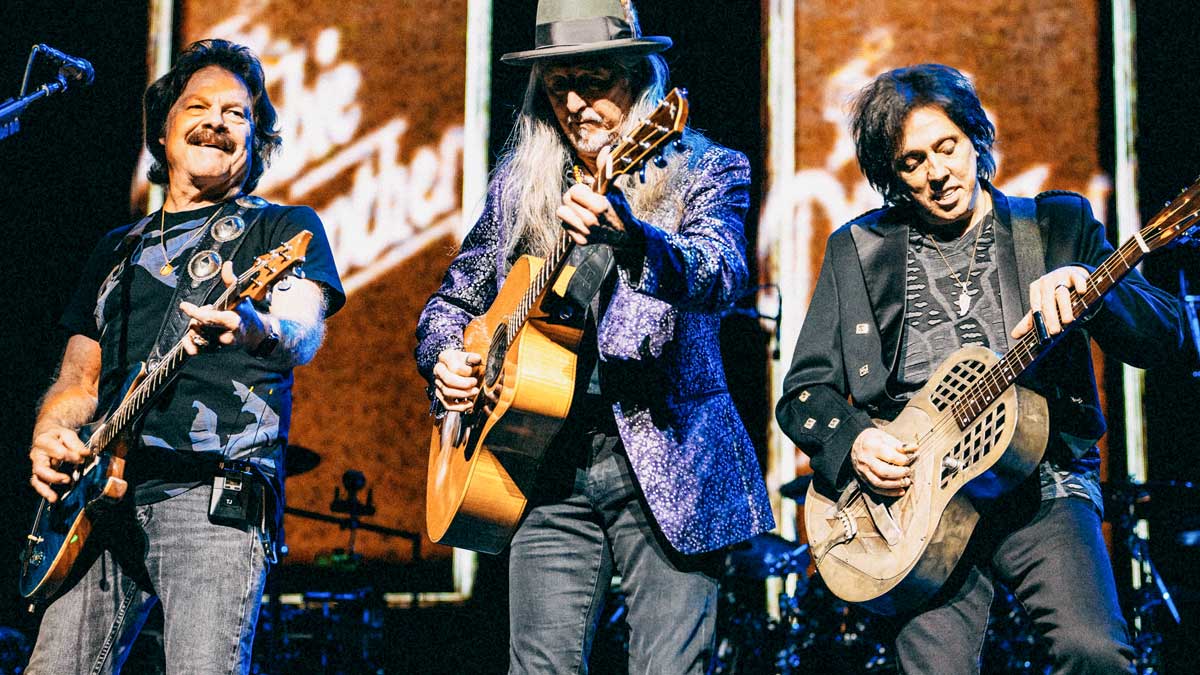
Tom Johnston a PRS Custom 24, Patrick Simmons with an Arthur Davis A1 Auditorium, and John McFee with a Republic Tricone Classic.
If you’re making a list of beloved bands with a long string of hook-heavy hits, the Doobie Brothers will surely be on it. Their new album, Walk This Road, features the creative core of vocalist/guitarist Patrick Simmons, vocalist/guitarist Tom Johnston, multi-instrumentalist John McFee, and vocalist/keyboardist Michael McDonald.
The news of Walk This Road generated significant interest because it’s the first album of fresh material with McDonald (who rejoined in 2019) since 1980’s One Step Closer. The band tours extensively, particularly in the summer at U.S. amphitheaters – perfect venues for multi-generational crowds to enjoy their feel-good music.
Producer John Shanks, who helmed their 2021 album Liberté, adds impressive guitar playing of his own to Walk. Simmons, Johnston, or McDonald separately co-wrote nine of the 10 new songs with Shanks; Simmons, McDonald, and Shanks teamed to write the other.
Walk This Road’s grooving title track features Johnston, Simmons, and McDonald sharing lead vocals with legendary R&B/gospel singer Mavis Staples. The upbeat “Call Me” and soulful “Learn to Let Go” are further standouts.
The band formed 55 years ago and released its self-titled debut album in 1971. Soon becoming mainstream favorites, Doobies classics include “Listen to the Music,” “Long Train Runnin’,” “China Grove,” “Take Me in Your Arms (Rock Me a LittleWhile),” “Takin’ it to the Streets,” “It Keeps You Runnin’,” “The Doctor,” and the number-one hits “Black Water” and “What a Fool Believes.” Best-selling albums include Toulouse Street, The Captain and Me, Takin’ it to the Streets, and 1978’s chart-topping Minute by Minute.
Tom Johnston with a Rickenbacker 620/12. Pat Simmons with a Dobro Phil Leadbetter signature model.
Despite Grammy wins for “What a Fool Believes” and Minute by Minute, long-overdue industry accolades for their full body of work have only recently come along. The band was inducted to the Rock & Roll Hall of Fame in 2020, and Johnston, McDonald, and Simmons are receiving the Songwriters Hall of Fame’s Performing Songwriters award this June.
Vintage Guitar talked with Simmons, Johnston, and McFee about making Walk This Road.
You’ve always had a creative urge and released new music. Many classic bands don’t and say that fans only want to hear the old hits. Patrick Simmons: If you’re having fun doing what you do, it transfers to the listener. I feel like we always give it our all – when we’re recording or playing live, whatever we do. And that comes across. It’s certainly subjective, but I feel this effort was a bit more interesting than our last album, which was great. I think having Mike there added an element that we didn’t have before. I can’t say enough about his singing and writing. He’s just such a talented guy and I’ve liked him in the band and outside the band, and it’s nice to have him back to make a record with us, and hopefully we’ll do more. I felt like everybody really stepped up a notch on this record.
Tom Johnston: The last one was a spur-of-the-moment thing, but it took longer than spur of the moment. We entered it thinking it was going to be an EP. We were on the road a lot.
John McFee: I think as musicians, we don’t want to just feel like, “Okay, we’re done and now let’s just go out and endlessly actively rest on our laurels.” This is a band that doesn’t want to do that. I don’t mean to criticize what other bands do or how they decide to go about their careers or their music, but with us, there’s a creative impulse that continues. And believe me, we don’t have any illusions we’re going to set the world on fire or something. You never know anything that people can respond to, and all of a sudden there’s a big positive reaction to a particular song or record. But even if there’s no reaction, we still want to be creative.
The musical styles the band is known for are all represented on Walk This Road. Surely that came naturally, not because it was expected of you. TJ: This is actually the first album I’ve been on with Mike, other than Takin’ it to the Streets. I had a song (“Turn it Loose”) on there. This is the first time all three of us have been writing for an album. It’s been a lot of fun, actually. It’s pretty cool. We’re lucky that people accept the three sounds and are good with it because I don’t know if that would’ve happened in the ’70s. Probably wouldn’t have, at least with any success, depending on the tune. It would’ve gone in one direction or the other like it did back then. In the ’80s and ’90s, we did a couple albums (Cycles and Brotherhood), then we did one in 2000 (Sibling Rivalry) and 2010 (World Gone Crazy), but they were all guitar-centric, and now we’ve got Mike involved and it adds a nice tone to everything.
John McFee with a Phantom Teardrop.
PS: Well, you’re making a big leap of assumption that we might plan anything! We’re totally off the cuff, pretty much everything we’ve ever done, so there was really no plan. There is a uniqueness to what we do together. It’s probably why we’ve been able to be together in a band for such a long time. We do things and things just seem to correspond – the songs themselves, the messages, the way we work together in terms of having sort of a symmetry that is somewhat reminiscent of what we’ve done in the past. Really, everything is an accident when it comes right down to it.
JM: It’s the Doobie Brothers. It’s the personnel especially. I’ll be honest, this is really Pat, Tom, and Michael’s album, and I’m just there. I can be supportive, but that’s their material. Those guys are the voices of the Doobie Brothers through the years. I think it is just natural that it’s going to end up striking people as, “Gee, that sounds kind of like the Doobie Brothers.”
Explain the writing and recording process with John Shanks at his studio. You often worked separately with him, but would more than one of you get together? PS: Both ways. At times, a few of us would work together, but generally this is the way John likes to work with us. I don’t think he works this way with everyone, but we started working this way with him a couple years ago. Really, during the pandemic, it was a different approach because everybody was basically isolating. So, when we started working with him, it was such a strange time period for getting together with other people. It’s like, “Should I wear my mask while we’re working? Do I need to?” And I did. I think for a while it was like, “Hey, this is weird writing with my mask on. I’ve got to take a break and go get vaccinated!” We took that approach and it worked so well and we had such a good time doing it that way. There’s a lot of new ways to record, which I love. We started that way during the pandemic, and we just rolled into it with this record, and it worked really well. I won’t say it’s regimented, but it’s formulaic and we don’t want to be all the time. We might want to be a little scrappy or looser, and I’m sure that’s something we’ll do in the future.
TJ: It’s kind of a funny thing when we get in the studio. That stuff just happens because I don’t know if anybody’s been writing a ton of songs on the road. That doesn’t happen for me. I don’t get creative on the road. Back in the ’70s maybe. Working with (Shanks) is another reason to go in various directions. We don’t go in with a plan. It’s just whatever happens in the studio, and that’s probably the magic about it – one of the things I really like. You don’t have anything set up before you get there. Yeah, I’ve written tunes before going to the studio, but these last two albums, we wrote them in the studio. And I’m not speaking for Mike or Pat. I don’t know what they had together when they walked in the door, but I didn’t have a lot. So, it’s spur of the moment. I like the spontaneity. I like the instrumentation on a lot of the songs. I like the direction. It’s different from what we did before and I really like that. I don’t like rubber-stamping everything you’ve already done.
Since Michael has been back in the band for a few years and you’ve been touring steadily, did that make things easier? TJ: Yeah, we have been on the road together since what, ’21? And each successive year we’re out doing all this stuff together, the camaraderie is there. I think that has a lot to do with what comes in on the album. I believe that.
Pat Simmons with a partscaster assembled at Westwood Music in the ’80s, Tom Johnston a PRS Custom 24, and John McFee a Shuriken, onstage in 2024.
PS: I agree with Tom. I hadn’t really thought about that, but I think you’re right. It was a bit more comfortable with each other and when you’re working on a song, you could hear the part you’d want somebody else to play. I certainly think there’s a uniqueness in our vocal plan that we’ve always had, but on this record, it really, really worked. In terms of the background vocals, we did a lot of singing together. I think that really makes a difference. It feels like a continuance of what we’ve been doing.
JM: Maybe I’m old-fashioned, but I grew up playing in bands and a band is, ideally, like a family. It certainly makes more sense and feels better to me when you’ve got a flow going of live performances and you get to know each other’s instincts by virtue of performing together. It makes a difference in the music.
John, you’re revered as a multi-instrumentalist and you played a variety of things on Walk This Road. Was it hard to decide which instrument to play, or was it obvious what each song needed? JM: I was given assignments, and it was fine. There was a certain amount of give and take in regard to that. For example, “Angels & Mercy” was a song where Pat said, “I want you to play violin, a bluegrass East-style violin part.” I started with that and then I ended up trying other things. By the time it was done, I also was playing harmonica, I added a resonator-guitar part, and I forget what all. A bit of that also happened with “State of Grace,” where I ended up playing pedal steel, cello, and mandolin. Once I put what they initially asked for, I got ideas and I ran ’em by them, and it worked. They ended up using my ideas in pretty much every case on this project. That doesn’t always happen. They give me a certain amount of freedom to try ideas.
You did most of your recording in your own studio, correct? JM: I’ve always had my own studio and I’ve been insanely busy working on all kinds of projects with other people during this whole time, too. In the case of this project, my contributions were mostly done at my place. On “Angels & Mercy” I did work a little bit in the studio with the guys. “Lahaina” I did on the road in my hotel rooms. That’s a Pat song, but we worked together. He coached me through what he wanted me to play on the resonator.
The band has always worked with producers, notably Ted Templeman, and now John for two albums. What are the benefits of having outside producers? PS: It’s important for me that I develop a personal relationship with our producer, whoever we’ve worked with in the past. I can only think of one time where we didn’t quite align with the producer and we had to make a change in the middle of recording or near the end of it. But, generally speaking, all of our producers have been great people and fun to hang with. We became close friends with every one of them – Ted, Charlie Midnight, Rodney Mills, and John. All have been just fantastic people.
TJ: You knew these people had lots of time in the studio and knew what they were doing. And that’s important. I’ve never worked with anybody that didn’t. But I’ve got to say that’s a big part of it. Good producers say, “What if you tried this?” They’ve all got their way, but it funnels down to the same thing – suggestions that help us. You may not always agree and sometimes you’ll try and go, “Well, that really does work,” or “It won’t work,” but at least you’re trying stuff, and that’s an ongoing process.
The Doobies’ latest album is Walk This Road.
JM: Every producer has a different style, a set of skills, or their way of contributing. It’s different with every producer. John is pretty assertive. I didn’t have much contact with him. I was sort of given the signs, “Hey, we need you to do these kinds of parts on this,” and then I did them on my own. I didn’t really get a lot of direct input from John myself. I’ve worked with producers who stay back and give the artists more freedom. Some really put their own stamp on it. And it can be great either way. I remember working on Elvis Costello’s first album (1977’s My Aim is True) with Nick Lowe. It’s a live album and he would not let me punch in a single note. We did overdub some background vocals, and Elvis doubled a few lines here and there, but most of that album is completely live. At the same time, I was living in England and my group, Clover, which included Huey Lewis, and working with Mutt Lange, who is the exact opposite. He is a perfectionist in everything. He’s great. I love Mutt. They’re two completely different styles of production, but they both can work.
Which guitars and other instruments did you play on this album? TJ: Most of the stuff was at John’s house. He has 150 guitars in there – PRSs, Strats, Teles. I didn’t bring any because then you’re flying around with gear that’s already there, more or less. He had tons of effects, tons of foot pedals. Everything you would need.
Acoustically, I used a Gibson J-50, or something old that sounded like it. I did all the tracks on the first five albums with a J-50 that, unfortunately, was stolen.
JM: On the title track, I’m playing slide guitar on my Line 6 Variax. I can go through variations of sounds and arrive at what I think works more easily using that type of a rig than having 20 different amplifiers set up with different microphones on them. I can choose the different amps and mics and stuff like that within my Line 6 Helix pedalboard and choose from different guitar models like the Les Paul or Strat or whatever. I used my Franklin pedal steel. My favorite mandolin is an Alvarez that’s really high-quality. The resonators were a Republic tricone and a National-style resonator. I’ve got a five-string acoustic violin I’ve had for a long time that I really like.
PS: I used John’s guitars. I’m a Strat guy, and he had some great ones that are really close to what I play. That was a real bonus. On almost all of the early Doobie Brothers records, I used an Epiphone Texan, and I walked in one day and he had this beat-up Texan sitting there. He says, “What do you think of this?” I picked it up and played it, and it sounded just beautiful. It was really gnarly-looking and old, but it played so beautifully and sounded so good. I ended up using it for almost all the acoustic stuff.
Road Tones
When artists sign on to work with writer/producer John Shanks, they are, of course, welcome to bring their own instruments. But sometimes – as with the Doobie Brothers’ Pat Simmons, Tom Johnston, and John McFee – it just isn’t practical. No fear, though, because Shanks is a true guitar junkie who can supply whatever sound a project might need, even for the hardcore vintage players. Here’s a look at some of the prime pieces the Brothers used on Walk This Road.
’61 ES-335, ’64 Strat in Shoreline Gold, and a ’59 top-loader Telecaster.
’63 Gibson Hummingbird, Shanks scoring this ’67 Epiphone Texan just before the sessions was a fortuitous twist of fate. “I brought it, not knowing that Pat used a ’67 Texan to record ‘Black Water,’ he said. “First thing he did was tune it, put on a thumb pick, and start playing that song. It’s beat to s**t but sounds incredible!” ’68 Gibson SJ-200.
’61 Gibson SG (left), ’65 Gibson Trini Lopez, ’73 Strat with a Tele pickup and Alembic preamp.
’68 Les Paul Custom (bottom left), and among the basses used by Pino Palladino and Bob Glaub were two Fender Precisions – a ’62 in Fiesta Red (faded to the misnamed “Salmon Pink”) and this sunburst ’68.
This article originally appeared in VG’s May 2025 issue. All copyrights are by the author and Vintage Guitar magazine. Unauthorized replication or use is strictly prohibited.
In Episode 3.10 of “Buy That Guitar,” host Ram Tuli is joined by Robb Lawrence and Kim Shaheen. Robb’s experience in the vintage market spans from the golden age of electric-guitar innovation to the modern world. Beyond simply studying the history, he lived it, documented it, and played alongside giants who created it. Kim is a veteran session guitarist and guitar collector with a career spanning more than five decades. Best known for his work in the late ’60s and ’70s London scene, he has brushed shoulders with rock legends.
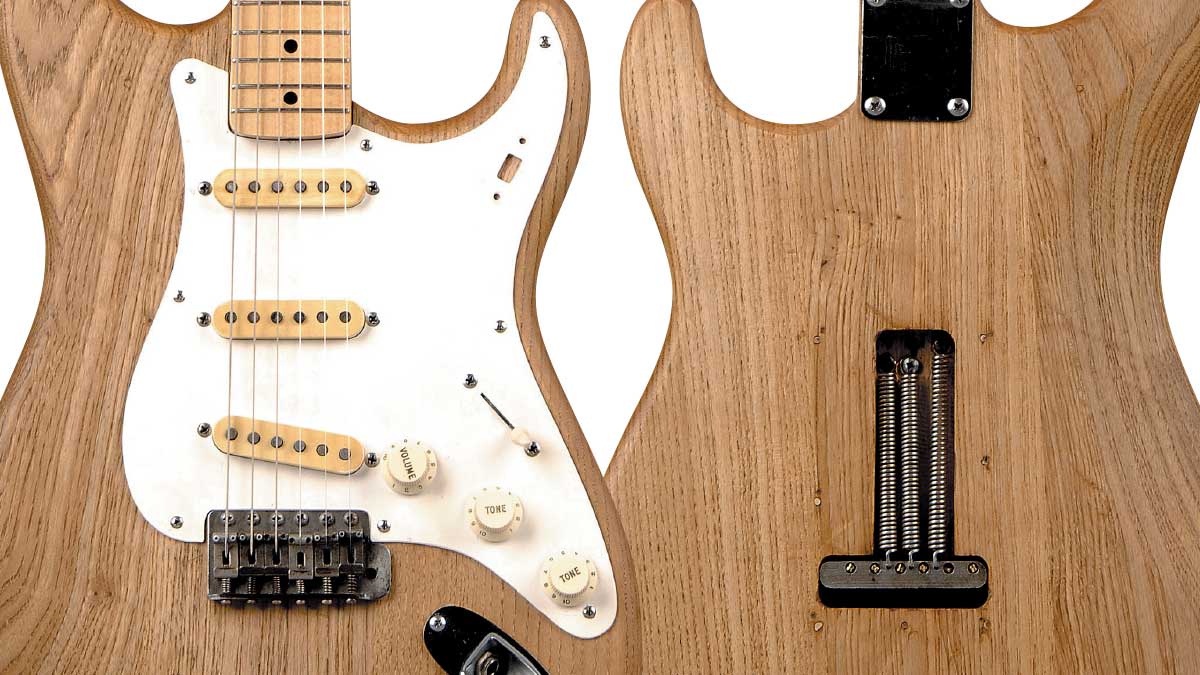
The assembled-from-parts Fender Stratocaster owned today by Jerry Madderra.
If you were a guitar – particularly one with a natural or translucent finish – your “fingerprint” would be the grain of the wood used to make your body.And if you were the assembled-from-parts Fender Stratocaster belonging to Jerry Madderra, that fingerprint would be the key to unlocking your important history.
Madderra’s family moved from Oklahoma to California in 1940, and Jerry was born in Orange County in ’43. His father, Thomas, played several musical instruments, and in the 1950s helped assemble a band to perform in local clubs. Jerry and an older sister recall that in 1954 or early ’55, their father and a friend brought home a box of guitar parts he acquired from employees of Fender’s plant in Fullerton, who had become familiar with him through one of the band’s gigs in nearby Silverado Canyon. “They heated up an old soldering iron on the kitchen stove and started assembling a guitar on the kitchen table,” Madderra said.
Thomas passed away in 1957 and never detailed the acquisition of the parts or the guitar. “From the family, I gathered that it was a prototype and that dad was doing some field testing,” he said. “But I’ve since found that the guitar had already been field tested and put into production, so I wouldn’t have seen the point of him doing field testing. But that was what was said in my family at the time.”
As a child and young man, Madderra didn’t have any interest in playing guitar. But when he did start in the late ’50s, it was on the made-from-parts Strat. In 1960, he took the instrument to high school wood shop and worked on the body. “My father or someone had put a varnish finish on it,” he said. “So I sanded it down and put a Candy Apple Red finish on it.”
The instrument would go through more changes in finish. In the early ’60s, Madderra played bass in a band called the Rhythm Crusaders, and loaned the Strat to the band’s lead guitarist.
Jerry Madderra in the mid 1960s with the Fender Telecaster on which he installed the Stratocaster neck.
“By ’62, I’d moved to another band called the Hustlers, and was playing guitar again,” he recounted. “I’d decided that Steve Cropper was the coolest guitar player around, so I bought a Telecaster like his. It was lighter and stayed in tune better than the Strat.”
So the Strat went into a closet and stayed there for more than 20 years. “But I liked the neck on the Strat better than the rosewood neck on the Telecaster, so I switched them. I played the Telecaster with the Strat neck until I got my draft notice in ’66, when I decided to sell everything.”
The Telecaster with the Strat neck and a ’59 Fender Bassman amp were sold to the House of Music, in Santa Ana, for $300. Madderra believes the Tele ended up with a singer/songwriter in Nashville with whom he has corresponded recently. In the mid ’80s, he played the Strat with the Tele neck, and in the late ’90s stripped the finish, exposing the bare wood. “I wanted to have it like it was when I got it. So I took it to guitar tech Doc Pittillo.”
Today, the guitar has a reproduction ’54 neck. Its three-way switch is a CRL 1452 with four patent numbers. The pickups have both been replaced. The owner says that one replacement occurred in about 1960, and the other in the ’80s.
The bridge is primitive, except for the saddles. “I don’t think they’re the ones Leo made,” Madderra said. “They appear to be 1954-production saddles that were put on the earlier bridge; they’re stamped with ‘Patent Pending’ and look like production parts rather than handmade, while the bridge looks handmade or perhaps like a prototype. The bridge plate never had chrome on it. And the inertia bar on the back is drilled for three springs, just like the one in the (Stratocaster prototype) photos taken by Leo Fender.”
Madderra thinks the neck that was on the instrument when his father got it was not the one on the instrument in those photos by Fender. “The one in Leo’s photographs seems to have a much, much darker finish than the one that ended up on my guitar,” he noted.
Madderra’s quest for authentication of the guitar began in the mid 1990s and later intensified when he posted images on an internet site called the Fender Discussion Page. He recalled that when the notion began to circulate that the body was from a prototype Stratocaster, “…there was a lot of skepticism at first. But we always knew it was a special guitar in that it wasn’t a production model.”
The primitive, apparently handmade bridge uses what appears to be production saddles stamped “Patent Pending.” The inertia bar on the back is drilled for three springs, just like that on the Stratocaster prototype photos taken by Leo Fender.
To help authenticate Madderra’s instrument, Vintage Guitar asked California repairman/guitarist Steve Soest to examine it. We also contacted Richard Smith, author of the comprehensive history Fender: The Sound Heard ‘Round The World.
“The important thing is that it’s historically significant because it’s part of the chain of events that led to the Stratocaster,” Soest said. “You can see from the grain pattern and the routing that it’s the same body in Leo’s photographs. What was left was the body, the bridge, and the vibrato tailpiece block. The body looks like it’s been sanded a couple of times.” Smith points out the first experimental Stratocaster had a vibrato that was unsuccessful and forced Fender to try another design. But there likely were other experimental instruments. Accordingly, Soest thinks the application of the word “prototype” to this guitar might be inaccurate.
“The significant thing with this instrument is the fact that there are previous photographs from when the guitar was new,” he said. “And it was significant enough that Leo put it on a chair and took pictures of it. But it was a shop model, not made to be shown to the public. It was a step in the development. A prototype would probably be a working/finished example that had a way to go. But nothing prior from that period has shown up.”
This article originally appeared in VG April 2008 issue. All copyrights are by the author and Vintage Guitar magazine. Unauthorized replication or use is strictly prohibited.
A lifelong vintage-guitar nut who has had “a million guitars,” Jeremy Graf’s all-time favorite is this 1961 Stratocaster.
A native of Knoxville, Tennessee, Graf was just seven when, for reasons he doesn’t remember, he asked for an Elvis Presley record. His mother obliged and brought home Elvis’ Golden Records, a compilation of ’50s hits.
“That was my introduction to the world of rock, rhythm and blues, blues, and rockabilly,” he laughed. “From that point, I was a so into Elvis that my grandmother suggested to my parents that I should see a doctor.” (laughs)
Opposite of nearly every other Babyboomer, when the Beatles landed in ’64, young Jeremy was disinterested, still wrapped in his Elvis fixation. He asked for a guitar and was given a beginner Silvertone acoustic that was, “…impossible to play, not helped by the fact that I couldn’t play anyway.”
Two years later, things changed when Rick Heinrichs and his family moved to town.
A suitably proud young Jeremy Graf in July of ’67, with the new Epiphone Casino he received as a gift on his 12th birthday. “That same month, I saw Hendrix open for The Monkees,” he said.
“Rick and his brother, Mark, had great-playing Guild acoustics and a Beatles songbook with pictures of the chords,” Graf recalled. “All of a sudden, I could make music, and I was hooked. For my next birthday, I asked for new Epiphone Casino.”
He signed up for lessons with (by chance) the brother of musical comedian and mandolin legend Jethro Burns.
“All he wanted to do was tell stories about Chet Atkins, and all I cared about was the Beatles, so I lasted three lessons,” he said with a chuckle.
At 13, Graf convinced his parents to let him take a bus, alone, to see the Miami Pop Festival in December of ’68, where he saw Marvin Gaye, Peter Green’s Fleetwood Mac, Terry Reid, and the Grateful Dead. The following year, he attended the Atlantic City Pop Festival and the West Palm Beach Pop Festival, which featured the Rolling Stones. The immersion fed his guitar jones, big-time.
“I’ve loved so many players through the years – Jeff Beck, Leslie West, Mick Ronson, Brian May, Jim McCarty, Robin Trower, and always, B.B. King,” he said.
By 16, he was playing in a rock trio doing tunes by Cactus, Deep Purple, Jeff Beck Group, and others. In 1971, he bought a ’64 SG Standard from a classmate.
Raggedy Anne at C.W. Shaws, Atlanta (left), 1979. Jerry Riggs has the Strat while Dave Ridarick plays an early-’60s Precision Bass Lead singer Don Train is in the middle. Graf and Riggs in 1981 (right), onstage at the Agora Ballroom, Atlanta. Graf has a ’75 Les Paul Custom, Riggs the ’61.
“I was hooked!” he said. “I loved everything about that guitar, including its beautiful form-fitted case with that marigold lining.
“Inspired by that guitar, I soon realized that I could make good money buying and selling cool old guitars, and I’d get to experience them. So if I wasn’t playing, I was out looking. I have a list of my first 50.”
After graduating from high school in the spring of ’73, he traveled to London, looking to absorb its musical culture for a few months while swinging a deal or two; he took a Les Paul Custom to sell and bought two 100-watt heads – a Marshall and a Hiwatt – which he shipped home. While there, he saw the famous Crystal Palace performance by Beck Bogert & Appice, caught The Sensational Alex Harvey Band, and David Bowie with Mick Ronson filming a bit for “The Midnight Special” at the Marquee Club.
Back in Knoxville by early ’74, he reconnected with the bass player and vocalist from his previous band, who had formed a band with a high-school kid named Jerry Riggs. They invited Graf aboard and started playing school dances and clubs. By year’s end, they had become Lynx and they signed with an agent who booked them in clubs throughout the south.
“It was a fantastic time to be in a band,” he remembered. “We worked steadily for the next few years, playing heavy two-guitar songs that we loved and went over well – Nazareth, Sweet, Thin Lizzy, Queen, ZZ Top. In Florida, it seemed like every city had at least two rock clubs.”
The Georgia Satellites ham it up with Dick Clark during the taping of their 1987 appearance on “American Bandstand.” The band was drummer Mauro Magellan (left), Rick Richards (holding the ’61 Strat), bassist Rick Price, and Dan Baird. Dick Clark is holding Baird’s ’61 Esquire (with a ’57 neck), bought from Steve Marriott.
When the band returned to play a night in Knoxville in early ’78, a friend told Graf about an old Strat at a pawn shop an hour away in Athens, Tennessee.
“The next morning, I raced there to check it out,” he said. “It was a ’61, hanging in the front of the store, and I was immediately taken by its cool vibe. It wasn’t great, playing-wise, but I figured I was just spoiled by all the great old Gibsons I’d been playing. It was only $175, so I bought it.
“The first thing I did was take it to my favorite luthier, Peter Jones, in Atlanta, and had him level the fretboard and install new frets. When he was done, it played perfectly.”
But at the next band rehearsal…
“I plugged it into my old small-box Marshall 50-watt and was appalled by its sound,” he laughed. “It was scratchy, noisy, and just… thin! I’d been playing a great, fat-sounding Les Paul Custom, so it didn’t compare. But when Jerry plugged it into his 100-watt Marshall running through an early Boss CE-1, the Strat sounded incredible. It he clear he that had found his sound.”
Even more than the front, its back bears the wear of an instrument that has played thousands of songs on hundreds of stages.
In mid ’78, Graf and Riggs moved to Atlanta to join friends in a band called Raggedy Anne, which opened for AC/DC fronted by Bon Scott, UFO with Michael Schenker, Judas Priest, Rush, The Babies, and many others.
“We were managed by Nazareth’s management and did a demo with their guitarist, Manny Charlton,” Graf recalled. “When it failed to secure a record deal, our front man, Don Train, left, and we formed Riggs. By the end of 1980, we had a deal with Irving Azoff’s Full Moon label, which was aligned with Warner Brothers.”
The label connected Riggs to producer Roy Thomas Baker, who helped them record two songs – “Heartbeat” and “Radar Rider” – that were used on the soundtrack to the 1981 animated feature film Heavy Metal (the latter accompanied the film’s opening sequence). The following year, Riggs recorded an album with Andy Johns.
Riggs played Graf’s Strat on everything the band recorded, and when their deal ended in ’83, Riggs accepted a gig with The Pat Travers Band. Knowing the Strat was basically part of him, Graf let him take it along.
In early ’85, Graf moved to Los Angeles, where he worked for a courier service before being hired to assist with random tasks in the studio at Virgin Records, where Warren Zevon was recording Sentimental Hygiene. When that was finished, Graf was hired to run the shipping department for the new label.
In ’86, the Pat Travers Band played the Roxy in Hollywood, and Graf was there, excited to see his old friend – and the guitar.
Jeremy Graf with the ’61 in 2017.
“I was surprised to see Jerry using his red early-’60s Strat, and mine was the backup,” he said. “He had put EMGs in his and it sounded great, so I figured it was time to reclaim the ’61.”
Shortly after, his old Atlanta friends The Georgia Satellites were in Los Angeles to do “American Bandstand.” Being a fan of “Jerry’s” Strat, Richards asked to borrow the ’61 for the show. Graf was happy to oblige.
In 1994, Graf and his girlfriend, Karrie, moved back to Atlanta, where they got married and he became a member of the Satellites. For two years, he toured the U.S. and played festivals in Denmark, Belgium, Sweden, and Switzerland, the ’61 Strat being his main axe, providing a counterpoint to Richards’ Les Paul Junior. They recorded an album in Denmark and played “Hippy Hippy Shake” and “Slaughterhouse” on the Danish TV.
After his stint in the Satellites, the Grafs moved to Chicago, where Jeremy stayed busy playing weekends in the lounge at the House of Blues Hotel. He then worked in music stores until their son, Tyler, was born, after which he became a stay-at-home dad for Tyler and their daughter, Madeline. The next decade saw him focused on family life.
In 2014, he assembled a band called The Instrumentalists, which worked up instrumental versions of songs with famous melodies. He followed that with another band, The Fundamentals, also doing strictly instrumentals.
“I still use the Strat whenever the opportunity arises,” he said. “Tyler, who is now 21 and quite the jazz drummer, will jam with me when he’s home from the Jazz Conservatory at Oberlin College, which extremely rewarding.” – Ward Meeker
The ’61 Strat can be seen being played by Jeremy Graf on Youtube; search for “Georgia Satellites Denmark.” Jerry Riggs uses his red Strat in his current gig with 38 Special.
This article originally appeared in VG’s May 2025 issue. All copyrights are by the author and Vintage Guitar magazine. Unauthorized replication or use is strictly prohibited.
1957 Maestro GA-45T Preamp tubes: two 5879; 6SQ7 tremolo; 12AX7 phase inverter Output tubes: two 6V6GT, cathode-bias Rectifier: 5Y3 Controls: Volume on each channel, shared Bad and Treble, tremolo Depth and Frequency Speakers: four 8″ Jensen DP-Alnico V Concert Speakers •Output: 15 watts RMS
In an era when the sub-20-watt combo is arguably the most popular guitar-amp format, it’s worth remembering that several classics of the category emanate from the ’50s. And just as interesting as the well-worn favorites, several lesser-known alternatives were also born in the decade of rock and roll.
In the December ’24 issue, we examined a handful of alternative club-sized classics of the ’60s, but plenty of portable combos from the decade before are viable tone machines in smaller venues or for studio recording. And while any vintage-amp fan’s mind turns quickly to the Fender tweed Deluxe, Gibson GA-30, or maybe an early Vox AC15 from the tail end of the decade, plenty of other worthy makes and models can be found among their less-famous contemporaries.
Of course, when we’re discussing “club-sized” amps, that’s a definition that fits the majority of creations from the ’50s, or at least those that aren’t even smaller than this. For one thing, few makers were producing amps that went much past the mid-20-watt range at best, and many that did were still reined in by inefficient speakers and/or softly compressing circuits. So, there are quite few amps born in the ’50s that can be contained in your average 100-seat venue, making for broad pickings from the era.
1957 Maestro GA-45T
Owned by Chicago Musical Instruments (CMI) in the ’50s, the same company that owned Gibson, the Maestro brand appeared on many of the conglomerate’s musical electronics products, as well as some pieces of gear that virtually paralleled Gibson models. This Maestro GA-45T combo, therefore, is a ringer for sure, and even something of a contradiction of the opening premise of avoiding the major makers, yet it presents enough quirks to sneak it into the fold. Made with a circuit that’s nearly identical to that of Gibson’s GA-40 Les Paul combo of the time – including its fat-sounding 5879 pentode-preamp tubes, the same 6SQ7-driven tremolo, and about 15 watts of power from a pair of 6V6GT output tubes – it was nevertheless promoted for use primarily with bass and accordion, and included a few significant design changes intended to suit those instruments… though these are still easily adapted to six-string guitar.
The most obvious of these is its four 8″ speakers rather than the Gibson’s single 12″, yet the cabinet is the same size and design (though adorned differently) and today’s players find it’s easy-peasy to bolt in a new baffle with the 12″ speaker of their choice. The Maestro also received an EQ section with Bass and Treble controls rather than the Gibson’s mere Tone control, and its output transformer is a little bigger (purportedly taken from one of the Gibson dual-6L6 models), likely to help it better reproduce its intended instrument’s bountiful low-end.
Plug in a guitar – especially with a 12″ speaker subbed in for the 4×8″ arrangement – and a GA-45T is capable of rich, warm cleans, and thick, juicy overdrive when pushed hard. Thanks to the 5879’s stout gain, they don’t fizz out as much as some 12AX7s or the like will in vintage amps when overdriven, and the entire package presents a robust tone that’s instantly vintage-certified while remaining extremely usable today.
’50s Flot-A-Tone Model 600 Preamp tubes: one 6SC7GT in preamp, one 6SN7 in phase inverter Output tubes: two 6L6GC, cathode-biased Rectifier: 5U3 Controls: two Volume, one Tone (disabled tremolo control) Speaker: single “heavy duty” 12″ Output: approximately 25 watts RMS
’50s Flot-A-Tone Model 600
If you’ve never encountered the unusual Flot-A-Tone you might initially feel the last chunk of that name is ambitious (regardless of what a “Flot” might be), but players such as G.E. Smith and Ry Cooder have discovered the genuine glories of the tone contained within, so these combos aren’t entirely the bargain-bin finds they once were.
Flot-A-Tone amps were made in Milwaukee, from the late ’40s into the ’60s, and were sold by accordion importers Lo Duca Brothers. But like so many amps of the era, they proved well-suited to the electric guitar, as well.
Just about every Flot-A-Tone appears to be a bit different inside. Word is that the manufacturer built them “on the fly,” using whatever suitable components were handy at the time an order came in. The design features an upper-rear-mounted control panel, with an umbilical cord descending to a main chassis mounted in the bottom of the cab, which reveals a semi-rats-nest, point-to-point circuit job. This one carries 6SN7GT and 6SC7GT octal preamp tubes, two 6L6 output tubes, and a 5U4 rectifier, and puts out something in the region of 25 watts through a single 12″ speaker likely made by Jensen or Rola.
Despite the semi-random construction and circuit topologies, most Flot-A-Tones sound surprisingly good, with a meaty, smoky tone that so many early ’50s, octal-preamp-based amps are known for, but with a little more bite and definition than you might expect, and plenty of compression when you dig in. Crank it up and it’s easy to induce a throaty wail out of that tubey breakup, and while it’s not especially loud even for a supposed 25-watter, it’s enough for smaller clubs with a diplomatic drummer.
Late-’50s Watkins Dominator Preamp tubes: three ECC83 (a.k.a. 12AX7) Output tubes: two EL84 Rectifier: EZ81 Controls: Mic Volume and Tone switch; guitar Volume, Tone, tremolo Speed and Depth Output: approx. 17 watts RMS +/- Speaker: two 10″ Elac Alnico drivers
Late-’50s Watkins Dominator
Long a sleeper among American fans of classic British amps, the cat has been out of the bag on the Watkins Dominator for quite some time, yet it’s still a firm alternative amid the more influential designs of the era. An accordionist who set up a music shop in south London after returning from his service in the Merchant Navy in World War II, Charlie Watkins was among the earliest entrepreneurs serving the amplified-music community. He began buying basic guitar amplifiers made by other jobbers around 1952, then commissioned his own builds shortly after. The iconic wedge-front Dominator arrived around 1957, after its sibling Westminster had occupied the same cab from the previous year.
Watkins’ amps were rough-hewn compared to those from competitors like Vox, Selmer, and Marshall, but a look inside this Dominator reveals that it’s not badly put together. The component count reveals a handful of the beloved Mullard “mustard cap” signal capacitors that enthusiasts drool over in vintage Vox and Marshall amps, and other parts are generally of a good quality. The amp’s relatively simple and somewhat generic circuit – likely taken from general applications of the time – has also been plenty emulated over the years, too, purportedly inspiring the design of the original Marshall “18-watter” models that also used dual EL84s.
As for the sound, it might be described as “classic mid-sized British,” with chewy mids, sparkling highs, and plenty of warmth and depth. The tremolo is deep and hypnotic, too. And while there can be a bit of a “hole” in the middle of the sound stage from those two outwardly-projecting 10″ Elac speakers in the split-V baffle when you’re standing front and center, it makes for a room-filling tone once you get back a bit. It’s the definition of late-’50s/early-’60s British cool, and not a bad performer, either.
1958 Montgomery Ward Airline Model 8514 Preamp tubes: two 12AX7, one 6AU6 Output tubes: two 6V6GT Rectifier: 6X5GT Controls: Volume and Tone for each channel, tremolo Strength and Speed Speakers: Two Rola 8″ Output: approximately 12 watts RMS
1958 Montgomery Ward Airline Model 8514
The Sears, Roebuck and Company catalog might evoke a more-nostalgic image for many guitarists with its iconic Danelectro-made Silvertone guitars and amplifiers, but Montgomery Ward came first as a company and as a mail-order catalog retailer, and its amplifiers were also being made by Nat Daniels’s Danelectro company before Valco of Chicago took over as supplier. Such is the case with this Airline Model 8514 combo, which is Danelectro through and through, yet with plenty of individuality to help it stand out from the catalog crowd. First on the quirks list is its 2 x 8″ speaker configuration, in a cabinet that could have housed a single 12″ or even a 15″ speaker, which would likely have made more sense in an amp deriving around 12 watts from a pair of 6V6GT output tubes.
A look inside the chassis reveals the somewhat helter-skelter circuit construction that fans will recognize in other Danelectro creations, yet which contributes to the raw, gritty character of these amps, rather than detract from their performance. Otherwise, the blueprint is standard for the day and not far off other mid-sized classics of the era such as Fender’s 5E3 tweed Deluxe. Daniels gave his own twist to most everything, though, and this Airline’s preamp opens up with a hotter 12AX7 versus the Deluxe’s 12AY7, yet that tube is reined in with fairly cold biasing and no cathode bypass cap. In addition, each of its two channels carries its own Tone control, and there’s onboard tremolo (labeled “Vibrato”) courtesy of a 6AU6 preamp tube.
Tone-wise, the Model 8514 delivers a sweetly lo-fi performance that’s high on character and low on headroom once you crank it up. Given its power and speaker complement, it’s suited to smaller venues (or miking-up) and makes for an interesting option in the studio.
1959 Ampeg Jet 12 Preamp tubes: two 6SL7 Output tubes: two 6V6GT, cathode-bias, with negative feedback Rectifier: 5Y3 Controls: Volume, Tone, Tremolo (speed) Speakers: Jensen Concert Series P12S Output: 15 watts RMS
1959 Ampeg Jet 12
It’s no surprise that an Ampeg sneaks onto most lists about under-sung vintage amps that offer great value. They were very well-built for the era, generally sounded extremely good, and can usually be had for a fraction of what the better-recognized classics are bringing.
Much of the reason Ampeg isn’t more often cited among the big-name collectibles of the late ’50s and ’60s stems from that fact that they were made for jazz, not rock and roll (as the late Ken Fischer, a former Ampeg engineer, reminded us in the December ’24 installment on ’60s club amps). The models that worked unexpectedly well for the rebellious new music – those that distorted easily – were drummed out of the catalog pretty quickly by jazz-loving company owner Everett Hull, after his favored musicians started complaining that they didn’t have enough headroom for the genre.
But there’s an easy way to root out the vintage Ampegs that will grind with many of the best of the tweed-era Fenders, Gibsons, and Valcos: look for the models with 6V6GT output tubes, and preferably also with more-common preamp tube types. Its circuit is somewhat closer to general-application amplifier circuits of the day than other Ampegs, yet it is far from generic in sound, looks, or overall performance. Its use of octal 6SL7 preamp tubes induces a slightly fatter tone at the start of the signal chain, which can break up sweetly when hitting the cathode-biased output stage hard. The 5Y3 tube rectifier enables plenty of the touch-sensitive sag we expect from amps of the day, and its Alnico-magnet Jensen P12S speaker translates the whole thing beautifully. Dial in the tube-driven tremolo (with just a Speed control and preset depth) and there’s a lot to love in a Jet 12 combo.
This article originally appeared in VG’s May 2025 issue. All copyrights are by the author and Vintage Guitar magazine. Unauthorized replication or use is strictly prohibited.
Sykes with a custom-color Strat in 1984. John Sykes 1984:Ray Palmer Archive/IconicPix.
The guitar universe was rocked by John Sykes’ death from cancer, December 21 at age 65. Forty years ago, the British guitarist rocked with high-volume bands like Thin Lizzy and Whitesnake, establishing himself before “shred” guitar had a name. Blazing on a Les Paul Custom, he was as fast as any human alive.
Sykes’ death wasn’t announced until January of ’25, and within hours of hearing the tragic news, Whitesnake guitarist Joel Hoekstra (VG, June ’23) told Vintage Guitar, “Like most rockers, I was a big fan of John’s work with Whitesnake, along with Thin Lizzy and Blue Murder. He played from the heart and had tremendous prowess both as a guitarist and vocalist. Unfortunately, I never had the chance to meet him, but always tried to pass along my admiration and respect for John through mutual friends.”
John James Sykes was born in Reading, England, on July 29, 1959, and started playing blues-rock licks on acoustic, initially inspired by Eric Clapton. Later influences included Gary Moore, Jimmy Page, and fretboard rippers like Michael Schenker and Uli Jon Roth. Barely 21, Sykes made his recording debut in 1980 with the band Streetfighter, which appeared on a New Wave of British Heavy Metal (NWOBHM) compilation, New Electric Warriors. The track, “She’s No Angel” already displayed nods to Thin Lizzy, with its melodic harmony lines.
Before long, he left Streetfighter to join Tygers of Pan Tang and helped record two solid albums in 1981.
“It’s very sad to hear of John Sykes passing,” Marty Friedman told VG. “His work with Tygers of Pan Tang was by far my favorite of the NWOBHM. A wonderful guitarist who played with bristling energy and new levels of ability. Forced me to up my game – something which I remain eternally grateful to John for.”
Thin Lizzy at the Manchester Apollo, 1983: John Sykes (left), Phil Lynott, Scott Gorham, and Darren Wharton
Subsequently, Sykes auditioned for Ozzy Osbourne’s band, but later found himself in the studio with Thin Lizzy frontman Phil Lynott. Working as a one-off duo, they conceptualized the pop-metal nugget “Please Don’t Leave Me.” A fast, tasty guitar solo bore hallmarks of the former Lizzy monster Gary Moore, who was off starting a solo career. The project was more than enough to convince Lynott to grab the 22-year-old Sykes, where he would play across the stage from Lizzy veteran Scott Gorham.
The result was the final Thin Lizzy studio album, 1983’s Thunder and Lightning, which has become revered as a metal masterpiece – arguably Lizzy’s only authentic heavy metal album. The lead single was “Cold Sweat,” co-written by Sykes and possessing an explosive solo with Van Halen-style tapping, over-bends, and brutal riffing. Another track, “Baby, Please Don’t Go,” was a metal master class containing one of the most-thrilling leads of Sykes career. As ’80s-era Thin Lizzy keyboardist Darren Wharton told Music Radar, “When [guitarist] Snowy White decided to leave Thin Lizzy, John was the natural choice to join us. While Snowy brought a laid-back, bluesy feel to the band, John introduced a heavier, more-intense element that Phil absolutely embraced.
“Recording Thunder and Lightning with John was also a creative highlight, full of excitement and energy,” he added. “John and I lived with Phil at his house in Kew Gardens… it was a special time, filled with camaraderie, music, and plenty of laughs.”
A mediocre live album, Life, was issued in late ’83, coming not long after Thin Lizzy disbanded in the wake of spiraling substance issues of Lynott and Gorham (Lynott died in January, 1986). After hearing the news of his former guitar partner’s death, Gorham said on social media, “So sad to hear about the passing of John Sykes. He and I played some sweet music together and he was a great musician. We’ll miss him.”
With Lizzy out of commission, Whitesnake’s David Coverdale feverishly tried to get Sykes into his band and, after heavy negotiation, landed the young guitar whiz. Their first task was finishing what became the Slide It In album, where Sykes appeared on the U.S. version while Mickey Moody and Mel Galley played on the U.K. mix. The album put Whitesnake on the map as a rising arena-rock draw and in January of ’84 they played to 500,000 fans at Brazil’s Rock in Rio festival.
Sykes in 1983.
Talking to the Metal Rules website in 2008, Sykes said, “I liked [David Coverdale’s] work with Deep Purple, especially, Burn, because I loved Ritchie Blackmore and all the Purple stuff before that. I think David sang great on that one, and he had an amazing voice – but I always felt he needed a rock player who could really drive him, not just strum along. He needed something like a kick in the arse, you know?”
The group reappeared with Whitesnake, titled 1987 in Europe and featuring new songs co-written by Coverdale and Sykes. The LP turned into a platinum seller, moving eight million copies, earning 24/7 video rotation, and establishing Whitesnake as a definitive ’80s “hair band.” MTV-encrusted hits included “Here I Go Again” (of which there are two versions, one with guitarist Adrian Vandenberg’s solo and another with studio man Dann Huff), as well as the Sykes-fueled power ballad “Is This Love.” But it was the guitarist’s riffs and faster-than-lightning solo on “Still of the Night” that established Sykes as a guitar god – it’s a metallic performance for the ages. Sykes later told veteran rock journalist/blogger Steve Newton, “[Producer Bob Rock] actually created my guitar sound on the Whitesnake album, and we’ve been friends ever since. I wanted to go for an early ’70s type of sound more than a late ’80s thing, and Bob was also into early Purple and Zeppelin, so it was great.”
A sad irony is that by the time Whitesnake became a smash, Coverdale had fired the band, as its dynamic had become acrimonious. The project was further delayed because Coverdale required surgery for vocal issues. The long and short of it was that Sykes was out, replaced on tour by Vandenberg and ex-Dio guitarist Vivian Campbell. Coverdale and Sykes never reconciled, but the former expressed his thoughts on social media, saying, “Just heard the shocking news of John’s passing. My sincere condolences to his family, friends, and fans.”
After being cut from Whitesnake, Sykes formed the power trio Blue Murder with drum icon Carmine Appice and bassist Tony Franklin (The Firm). Their 1989 debut and ’94 follow-up Nothin’ But Trouble provided potent MTV metal, earning a cult following for “Jelly Roll” and the Whitesnake-styled “Valley of the Kings.” Despite being well-received, Blue Murder never connected with fans on a mass scale and, with the arrival of grunge and alt-rock in the ’90s, was all but doomed as a commercial venture. In hindsight, however, the project not only reinforced admiration for Sykes’ guitar prowess, but also his powerhouse vocals. In fact, at times he sometimes sounded more like David Coverdale than David Coverdale, notably on the stomper “We All Fall Down.”
Onstage with Thin Lizzy in 2007.
Sykes is universally identified with his ’78 Les Paul Custom with Dirty Fingers humbuckers – a tour-ravaged Black Beauty with plenty of battle wounds. Behind him, a row of 50-watt Marshall JCM800 heads or Mesa/Boogie Coliseum heads, along with 4×12 cabinets provided a mighty backline roar. Even decades later, the gigantic tones of Sykes-era Thin Lizzy and Whitesnake remain a thing of crunchy wonder.
In the mid ’90s, Sykes reconnected with Scott Gorham, drummer Brian Downey, and keyboardist Wharton for atouring-only Thin Lizzy lineup. The show proved a powerful homage to Lynott and carried on for over a decade, with John offering a potent reinterpretation of Lynott’s vocal phrasing and style. The live One Night Only appeared in 2000; at the same time, Sykes launched a solo career with a few modest-selling albums and singles.
On social media, fellow Whitesnake alumnus Doug Aldrich posted, “I met John several times and will never forget the conversations we had. He was a funny and cool guy [who] was fierce on the guitar and sang his ass off. John is now up there with Eddie, Gary, Randy, Jimi, and a whole lot of our heroes.”
Billy Idol guitarist Steve Stevens summed up Sykes’ impact with this pithy post: “Hearing that John Sykes has passed. Man, his work on the 1987 Whitesnake album was just incredible. You’ve got 12-year-old kids on Youtube still learning his stuff!”
Pete Prown is music editor at Vintage Guitar and author of Ultimate Heavy Metal Guitars: The Guitarists Who Rocked the World.
John Sykes
Arc Of An Icon
Sykes and his Les Paul with Whitesnake in September, 1984.
In the golden era of guitar that was the ’80s, A-list players like Edward Van Halen, Slash, Stevie Ray Vaughan stood alongside guys like Michael Hedges, Allan Holdsworth, Leo Kottke, Andy Summers, and Craig Chaquico, creating a great stylistic melange.
Also contributing was John Sykes, who became known for his idiosyncratic style and flair for the dramatic. Influenced by Jimmy Page, Eric Clapton, and Ritchie Blackmore, Sykes was a Gary Moore disciple who followed in his footsteps when he joined Thin Lizzy in 1984. Sykes’ breakout performance was on the 1987 self-titled Whitesnake album, but no matter the setting, his playing was consistently great. Here, we offer a curriculum vitae.
Streetfighter
Sykes’ recording debut happened in 1980, with the Streetfighter track “She’s No Angel,” on the compilation NWOBHM Thunder: New Wave of British Heavy Metal: 1978-1986. Sykes’ playing is fast, melodic, and raw, with edgy, spiraling solos that would remain a trademark of his musical identity.
Tygers of Pan Tang
Sykes joined Tygers of Pan Tang for a trial-by-fire debut in front of 60,000 people at the Reading Festival in 1980. He performed on the albums Spellbound and Crazy Nights and played on the tracks “Love Potion No. 9” and “Danger in Paradise” on 1982’s The Cage.
With Tygers, Sykes’ playing was more-polished and confident. Tunes like “Gangland,” “Hellbound,” “Don’t Stop By,” and “Mirror” display muscular riffs that leaned heavily into the British metal style of the era. His muted runs, heavy vibrato, harmonized guitar lines, and artificial harmonics became a mainstay of his artistry.
Thin Lizzy
After leaving Tygers, Sykes auditioned for Ozzy Osbourne, then re-recorded with Streetfighter before briefly joining vocalist John Sloman and Whitesnake bassist Neil Murray in the Wales-based Badlands. He then replaced Snowy White for Thin Lizzy’s final album, Thunder and Lightning, released in ’83. Joining forces with a visionary band that included bassist Phil Lynott and guitarist Scott Gorham, Sykes was entering his prime.
With Lizzy, his growth was huge. On the title track, he unleashed blazing staccato lines and heavy vibrato. Highlights include the haunting “The Sun Goes Down,” the severely rocking co-write “Cold Sweat,” “Holy War,” and the riveting “Baby Please Don’t Go.”
Thunder and Lightning was Thin Lizzy for head bangers, and Sykes was key in its heavier, more-intense guitar sound. It charted at #4 on the U.K. album charts and was followed by Life: Live, recorded in March of ’83. A must-own for aficionados, the double album was mostly recorded at the Hammersmith Odeon during the band’s farewell tour and features former bandmates Eric Bell, Brian Robertson, and Gary Moore. Sykes is on fire, particularly on the power ballads “Still In Love With You,” and the definitive version of “Don’t Believe A Word.” It features not one but two epic guitar solos in each song. The live versions of “Are You Ready,” “Got To Give It Up,” and “Waiting For An Alibi” are sweltering. On the song “The Rocker,” Bell, Moore, and Robertson join Sykes and Gorham in a firestorm of pentatonic passion.
Whitesnake
As Lizzy was disbanding, David Coverdale was looking for a flashy guitarist to match his stage presence. Adrian Vandenberg reluctantly declined, and Sykes pinged Coverdale’s radar when their respective bands shared festival bills on European tours. After passing on Michael Schenker, Coverdale courted Sykes by making him an offer he couldn’t refuse — lots of money.
Before Sykes joined, the U.K. version of Slide It In had already been recorded and British fans ate it up, but it received harsh reviews by the British press for its poor production and trite lyrics. Geffen Records refused to release the album in the U.S., so Sykes and Murray were flown to Los Angeles to re-record certain guitar parts, layer others, and replace all the bass. Producer Keith Olsen remixed the album, and the re-recording was a success, with improved production and a heavier, more-modern blues-rock sound. Sykes and Murray were confirmed as members of Whitesnake in January of ’84, culminating in Sykes playing in front of 500,000 people at the Rock in Rio Music Festival when they replaced Def Leppard the following year.
The U.S. version of Slide It In became Whitesnake’s first major success. Coverdale’s middle finger to the British press, it sold more than half a million copies and put the band on the map, partly due to Sykes’ aggressive playing. On the 2019 remaster, Sykes plays to complement the song, respectfully building from the ideas of guitarists Mel Galley and Micky Moody. His contributions are lyrical, adding girth, emotion, and his trademark pinch harmonics.
Exhibit A is Sykes’ re-do of the guitar solo on the title track. While Moody’s version is perfection, Sykes builds on his ideas, taking it to a more-modern, fiery, and melodic place. He finishes the solo with an epic arena-rock crescendo. Live versions of these songs with Sykes are breathtaking.
The 1987 Whitesnake album made Sykes famous. Deeply involved in co-writing nine of the 11 songs with Coverdale, his solo on the re-recording of “Crying in the Rain” is among the greatest of that era. But, on “Still of the Night,” he unleashes truly crafty six-string drama; dynamics, tension, release, bombast, and his distinctive vibrato are used to masterful effect.
Leaning into a polished and contemporary hard rock sound, Sykes and Coverdale recorded the album then parted ways. Adrian Vandenberg was hired to replace Sykes’ guitar solo on “Here I Go Again.” Dann Huff plays the solo on the radio mix.
The album is an immaculate blues-rock masterpiece. Coverdale, with his British metal-frontman persona, was the perfect emcee to deliver the songs with swagger, bolstered by Sykes’ guitar mastery. The opening riff of “Bad Boys” rocks with all-out gusto, while the ominous Led Zeppelin atmosphere of “Still of the Night” displays Sykes’ trademark melodies, muted 64th notes, lyricism, and epic crescendos.
While Sykes could light up the fretboard, he could also dig deep, delivering soulful guitar lines and beautifully harmonized backing. On the sugary ballad “Is This Love,” his silky smooth legato lines are cherry filling. Whitesnake’s seventh record, it became Coverdale’s most successful album to date, selling more than eight million copies in the U.S. while reaching #2 on Billboard, where it resided for 10 weeks.
Blue Murder
In late ’87, Sykes began recording demos for a band that was to include drummer Cozy Powell, bassist Tony Franklin, and vocalist Ray Gillen. After hearing them, Geffen Records A&R exec John Kalodner encouraged Sykes to front the band himself; he then added drummer Carmine Appice. Produced by Rob Rock, its self-titled debut was released in April of ’89 and is Sykes at his most-opulent. Songs like the title track display his trademark soloing, while “Valley Of The Kings” is his most-epic. Lost on most guitarists was his powerful singing within the context of arena rock, acoustic country blues, and accessible pop-metal.
One of that era’s finest hard-rock records, Blue Murder peaked at #69 on Billboard and garnered positive reviews. “Jelly Roll” became a minor hit, receiving rotation on MTV, peaking at #15 on Album Rock Tracks. Selling an estimated 500,000 copies in a changing music scene, the album failed to meet expectations.
During this period, Sykes was considered to join Def Leppard after singing background vocals on the Adrenalize album. He lost out to Viv Campbell.
Moving on, Skyes released Blue Murder’s second album, Nothin’ But Trouble, in August of ’93. He’d continued writing and playing in the style that made him famous, but also presented even heavier material; mammoth riffs infiltrated passionate songs with big choruses, ethereal dynamics, over-the-top soloing, and rich Les Paul tones. “Cry For Love,” “I’m On Fire,” and “I Need An Angel” is top-tier. “We All Fall Down” peaked at #35 on the Album Rock Tracks chart.
After the album essentially failed, Appice and Franklin left, replaced by drummer Tommy O’Steen and bassist Marco Mendoza. They released the live Screaming Blue Murder: Dedicated to Phil Lynott in 1994, which contained a mix of songs by Thin Lizzy, Whitesnake, and Blue Murder. Incendiary versions of “Cold Sweat,” “Dancin’ in the Moonlight,” “Still of the Night,” and “Jelly Roll” are worth the price of admission. Unfortunately, Sykes was dropped by Geffen Records, and the band then split.
Solo
Sykes’ solo debut came in ’95 with the release of Out of My Tree, followed by Loveland and 20th Century (both ’97), Nuclear Cowboy (2000), and Bad Boy Live! (’05). He also joined a reformed Thin Lizzy from ’96 to ’09 and auditioned for Guns N’ Roses in ’09. In ’11, he began recording demos for a power trio with drummer Mike Portnoy and bassist Billy Sheehan. Tentatively called Bad Apple, the project folded due to scheduling and personality conflicts. After Richie Kotzen replaced Sykes, the band morphed into the highly successful Winery Dogs. In January of ’21, Sykes released “Dawning of a Brand New Day,” followed in July by “Out Alive.”
Gear
Sykes’ main guitar was a black ’78 Les Paul Custom with Dirty Fingers pickups. He also used a ’59 Standard on Loveland, played a ’61 Strat on “Is This Love,” and a Charvel with a Floyd Rose on “Black-Hearted Woman” and “Ptolemy.”
A Marshall user who favored 50-watt JCM800 heads modified by José Arredondo paired with 4×12 cabinets, with Whitesnake and the first Blue Murder album, Sykes used two Mesa Boogie Coliseum heads, Mark III preamps, rackmount units with Dual Rectifiers, Mark IIC+ heads, TriAxis preamps, a Strategy power amp, a rackmount Dunlop Crybaby, Lexicon PCM 41 and PCM 70 delays, and an H&H V800 power amp. Later, he was partial to the EVH 5150III with EL34s.
Legacy
To hear the cream of Sykes’ six-string artistry, Thin Lizzy’s Thunder and Lightning, Life: Alive, Whitesnake, Blue Murder, and Bad Boys Live! are key. Sykes was no ’80s shredder clone; he wielded the theatrical intensity of Gary Moore, the scalar melodicism of Randy Rhoads, and techniques from Edward Van Halen, creating a blues-based hard-rock aura. With his British blues-rock attitude, signature vibrato, and out-of-the-box phrasing, he brought new life to palm-muted bass notes, bent harmonics, and pick slides.
His soloing incorporated an array of hard-rock techniques, such as super-fast alternate picking, pinch harmonics, exaggerated vibrato, muted pentatonic runs, and spiraling scale sequences. His playing was otherwise highlighted by behind-the-nut bends, harmonics, ostinato passages, seamless legato, and rapid-fire picking. Compositionally, the themes in his music dealt with straightforward guitar-centric hard rock as well as grandiose Egyptian-tinged mythological imagery and roots-oriented compositions like “Jelly Roll,” with its Db-Ab-Db-Ab-Ab-Db tuning (low to high).
His influence was deeply felt by guitarists in the hard rock and metal community like Zakk Wylde and Slash, as well as subsequent members of Whitesnake, including Adrian Vandenberg, Vivian Campbell, Steve Vai, Reb Beach, Joel Hoekstra, and Doug Aldrich.
This article originally appeared in VG’s April 2025 issue. All copyrights are by the author and Vintage Guitar magazine. Unauthorized replication or use is strictly prohibited.
The Combo 600’s back reveals extensive routing and basic wiring for the horseshoe pickup.
Marc Schoenberger was part of the early-’70s vanguard on the Southern California guitar scene – not as a gigging musician, but among the crowd that raced the 101 freeway to check out old guitars every time a new issue of the Recycler hit the streets. He’d also been repairing guitars for friends and local shops since he was a kid.
One of his repair clients was Eddie Frawley’s store, Central Coast Music, in Morro Bay, where a stop one day in 1984 became memorable. He had a repair to deliver, but was also picking up $1,300 for a ’36 Martin R-18 that he’d consigned. But, just minutes before he arrived, Frawley had hung an old Rickenbacker Spanish-style guitar on his wall. Being a lap-steel collector, Schoenberger immediately recognized its “horseshoe” pickup.
“I’d been thinking about building something like it so I could use one of those pickups I had laying around,” Schoenberger said. “So I grabbed the guitar and asked Ed if I could take it in exchange for the money from the R-18. He nodded and I walked out maybe two minutes after I’d arrived (laughs)!”
Having never seen anything like it, Schoenberger knew nothing about the guitar.
“Back at my shop, I looked at it and thought, ‘Well, it’s been refinished,’ because I could see gray primer. But when I removed the back cover, I started to think that was probably the only finish it’s ever had. Taking a closer look at the pickup, I figured it had been hacked out of a lap steel.”
Other details added to the intrigue.
Marc Schoenberger’s Combo 600 – a very early Spanish-style Rickenbacker. The back is closed with a polished aluminum cover.
“It looked like the bridge had been moved – twice – and it still didn’t intonate (laughs). Looking at the saddles, you think, ‘What’s going on here?’ and ‘How did they forget to use blocks to anchor the screws into the back plate?’ The truss rod is poking out from the top of the neck, and it’s put together with random screws.”
The oddity hung on Schoenberger’s shop wall, garnering little attention – until two years later, when a stranger walked in, looking to sell an Epiphone Sheraton (finished in Burgundy Mist) and noticed the Rick hanging on the wall.
“He said, ‘Oh, you bought my guitar!’’’ Schoenberger recalls. “I was surprised! Of course I asked, ‘What do you know about it?’ and he proceeded to tell me how he’d bought it at a garage sale from guy who’d worked at Rickenbacker and kept it in his office. He said, ‘This is an important guitar because it was the very first one they made,’ and he remembered taking it around the corner to an autobody shop to have it painted. When the old guy started getting weepy, he thanked him and left with it.”
Though happy to have learned something, Schoenberger didn’t dig any deeper.
“Not knowing any names and not having Richard Smith’s Rickenbacker book – which wasn’t published until five years later – I was basically stuck.”
A recognized authority on National guitars, Schoenberger remained only casually interested in Rickenbackers – until 2010, when a copy of Smith’s book landed on his desk. He leafed through it…
“On page 65 was a picture of Ward Deaton, who the caption says was Rickenbacker’s longtime factory manager until he retired in the early ’80s. Thinking that if I could track him down, he’d probably know something. I found an Atascadaro phone book from ’86, and there was a listing for a Stacy Deaton. I called several times over the next week and nobody ever answered.”
The trail cold, Schoenberger was left with a lot of unanswered questions, in part because early Spanish-style Ricks are from the days when company owner F.C. Hall and guitar designer Roger Rossmeisl were figuring out how to make them, and they were never consistent from one to the next. The Combo 600 and 800 were designed by Hunt Lewis then adapted for production by Rossmeisl; the body outline and original tapered headstock shape were by Lewis, while the German-carved top and production headstock were Rossmeisl’s.
Also, time has since revealed that Deaton and his wife, Barbara Jean (who wound the pickups on the Rick 325 that John Lennon played for The Beatles’ first appearance on Ed Sullivan) lived in Costa Mesa and had two sons, but no daughters. Ward passed away in 1993, Barbara Jean in 2018.
The truss extends further than modern examples. The pickup grounds to the aluminum back plate. Pots are labeled in pencil – the top “Volume,” the lower “Tone.”
The serial number on Schoenberger’s guitar dates it to 1954 – the first year of production (there are two prototypes with tapered headstocks, one of which resides at the Rickenbacker factory), and its white finish makes it exceedingly rare. He hopes its story reminds guitarheads of Rossmeisl’s genius (see page 26 for a feature on his 12-string models).
“All these years later, I’m still amazed at his radical design ideas,” he said.
Guitar collector Collin Whitley notes that Rickenbackers are gaining traction in the vintage market.
“If you’re into vintage guitars for the historical aspect, there is a lot to love about Rickenbacker,” he says. “The brand played a pivotal role in guitar history, and its instruments have a distinct tone and character. For many of us who were too young to collect vintage guitars in the ’80s and ’90s, Gibson, Fender, and Martin were cost-prohibitive, but older Ricks were relatively inexpensive and had such great history attached to the brand. They were my gateway.”
Schoenberger has contacted Rickenbacker about buying his Combo 600, but they’ve declined, so he’s hoping to find a good home for it.
“I’m looking at you, Mike Campbell,” he laughs. – Ward Meeker
Special thanks to Martin Kelly, author of Rickenbacker – Pioneers of the Electric Guitar.
This article originally appeared in VG’s April 2025 issue. All copyrights are by the author and Vintage Guitar magazine. Unauthorized replication or use is strictly prohibited.
Amp and photos courtesy of David Figie. 1964 Supro S6420 Preamp tubes: two 12AX7 Output tubes: two 6L6GC Rectifier: 5U4 Controls: Volume, Tone Speakers: Jensen C15PS Output: 35 watts RMS
Despite their catalog-grade status, Supro amps have been used by several noteworthy guitarists. For many, the sturdy Thunderbolt is the preferred workhorse.
It’s been a long time since Supro amps were any kind of secret find or hidden gem; players have long recognized the eccentric splendors of certain mid-sized examples, with their thumping tremolo and gritty-but-gutsy tube tone. Also, reissues by the revitalized Supro company have brought the name back front and center.
One of the ubiquitous models among the lineup – and an amp often thought of as a Supro cornerstone – the Thunderbolt arguably delivers less of the quirky signature Supro circuit characteristics while somehow remaining in step with the legend.
Simplicity itself: the back reveals the bottom-mounted chassis, sparse control panel, four tubes and 15″ Jensen speaker that make it all happen.
Introduced in 1964, the Thunderbolt was promoted purely as a “bass-guitar” amp, as stated on the combo’s control panel. Like other low-powered early offerings for the four-string, however, it has been used far more often by guitarists who quickly discovered that many of the qualities contributing to an underpowered all-tube bass amp can equate to just right with a higher-register instrument plugged in. Riding atop the tone, of course, is the perpetually cool Supro styling, comprising a black “rhino hyde” covering, silver grillecloth with black pinstripes, and that iconic logo with the lightning-bolt swoosh. And it’s fitting that the image speaks to an ageless form of hip in the guitar universe.
Supro’s origins date to the days before the electric guitar and the formation of the National Resophonic guitar company circa 1926, with its resonator guitars. Supro’s parent company, Valco, was founded in ’35 by Victor Smith, Al Frost, and Louis Dopyera (the company name derived from the first letters of the first names of each, plus “co”), who had bought the remnants of National Dobro for that purpose.
Smith and Frost had been employees of National, while Dopyera was co-owner, having helped establish National and then Dobro resophonic guitars alongside Adolph Rickenbacker and George Beauchamp in the mid/late ’20s (Beauchamp and Rickenbacker went on to produce some of the first commercial electric guitars and amplifiers under the Rickenbacker brand by the mid ’30s, as the quest for loud evolved from aluminum resonator cones to tube-powered pulp paper). Just a year after founding the company, Dopyera, Smith, and Frost moved Valco from Los Angeles to Chicago, which was then the hub of the musical-instrument industry in the United States. It was also a central location from which they could easily service the many house brands that would form the core of their clientele, including Gretsch, Kay, Harmony, Airline, Oahu, and a few others.
Just two inputs along with Volume and Tone controls occupy the front panel of this “Bass-Guitar” amp.
Supro’s amplifier line of the early/mid ’60s carried modern styling, though its circuits were still basic, as was its construction, with the chassis mounted in the bottom of the combo cabinet with a slanted, rear-facing control panel – a format that had faded from popularity a decade or more before. The ’64 catalog “boasted” of the Thunderbolt: “No frills – no fancy circuits – no extra weight – just fine quality and clean, true bass response. For the mobile Bass player and those ‘one-night’ stands.”
Indeed, the circuit uses just about the bare minimum of stages and components to get signal through the preamp to the output stage. One lonely 12AX7-derived triode carries it through the Volume and Tone potentiometers in the amp’s single channel – and a coldly-biased one at that – with half of that tube remaining unused, while the phase inverter employs the second 12AX7. A pair of 6L6GCs generate approximately 35 watts, cathode-biased with no bypass capacitor in place, presumably to avoid swamping the stage with unflattering low-end.
This catalog listed the amp at $179.50 – $10 more than a Princeton Reverb made the same year, and we know which one most guitarists would take today! Our featured example remains with its original owner, VG reader David Figie.
“In 1964, I was 11 years old and playing in a band called The Rising Sons, in West Allis, Wisconsin,” he said. “I played a Gibson EB-0 and my dad bought me this Thunderbolt. It was not good for bass, so Dad bought me a Gibson Titan.”
There’s about as little going on inside the chassis as out – a spaghetti junction of wiring, perhaps, but not all that busy.
Many agreed, apparently, and Valco attempted to firm-up the Thunderbolt’s performance through the decade, adding further bracing to the baffle to try to help the 15″ Jensen C15PS – and the cabinet in general – stand up to the low-end onslaught. In ’68, they revamped the design. Even before, however, guitarists had begun discovering what the stock Thunderbolt S6420 could do – Jimi Hendrix among them, who toured one with Little Richard and the Isley Brothers before heading to London and gaining massive solo fame.
Figie’s Thunderbolt sat unused a lot longer than that, though he never thought to sell it.
“Occasionally, I played my brother’s Rickenbacker 366/12 convertible through it. In 1989, I bought a Stratocaster and have been using the Thunderbolt ever since. I replaced all the tubes; I still have all the originals, and everything else is original. This amp sounds great for guitar!”
Designed to get a bass signal from input to output with minimal flubbiness or distortion, the Thunderbolt is predisposed toward a warm, rich, and slightly woolly tone, which sounds best when pushed to drive those 6L6GCs into a little breakup. There’s a whole unused triode stage sitting there in the preamp’s lone 12AX7, which can be used to add another gain stage or an active EQ stage, but most guitarists who dig the Thunderbolt love it for what it does naturally. That might not be thunderous by nature, but it’s a juicy, throaty, edge-of-breakup drive that epitomizes a certain breed of vintage tone, and has a lot to offer on its own.
This article originally appeared in VG’s April 2025 issue. All copyrights are by the author and Vintage Guitar magazine. Unauthorized replication or use is strictly prohibited.